
“Another week, another request to publish 300 pages by Friday.”
That’s the moment most SEO managers stop arguing about content velocity and start looking for a system. Programmatic SEO for content teams is that system, but only when it’s built with governance, data quality, and page level usefulness.
This guide shows how to plan, build, launch, and maintain pSEO for content teams without shipping a thousand near identical pages that do nothing for users.
You’ll get a practical decision framework, template rules that keep pages meaningfully different, an indexation policy, and a rollout plan you can actually run.
Key Takeaways
- Programmatic SEO scales pages with templates plus structured data, not shortcuts.
- Choose one pattern first, validate quality, then expand safely.
- Every page must add unique value, or it becomes scaled content risk.
- Variation is not only wording, it is structure, data, and intent fit.
- Indexation should be selective, using rules instead of gut feel.
- Great pSEO depends on dataset readiness and ongoing refresh cycles.
- Strong internal linking and hubs turn pSEO into a compounding system
What is programmatic SEO for content teams
Programmatic SEO for content teams is a way to publish hundreds or thousands of pages by combining a repeatable page template with a structured dataset. Done well, each page answers a distinct query with distinct usefulness, even if the layout is consistent. Done poorly, it becomes a factory of thin pages that exist mainly to rank.
Programmatic SEO is not new. If you have used major directories, marketplaces, or large catalogs, you have used programmatic pages. The difference in 2025 is that content teams can now generate pages faster than they can govern them, which is why the operational model matters more than ever.
A useful mental model is “template plus dataset plus rules.” If any part is weak, your output becomes obvious and unhelpful.
A simple infographic that works here is a three layer diagram:
- Layer 1: Queries and intent clusters
- Layer 2: Dataset fields and validation rules
- Layer 3: Template blocks with conditional logic
Why content teams are adopting pSEO in 2025
Programmatic SEO becomes attractive when you are facing search demand that is naturally combinatorial. Think “tool A vs tool B,” “integration between X and Y,” “best solution for persona Z,” “price of category in region,” or “feature by industry use case.” These patterns scale because the intent scales.
At the same time, Google has been explicit that scale alone is not the win. Its spam policies describe scaled content abuse as creating many pages primarily to manipulate rankings rather than help users, regardless of whether it is generated by automation, humans, or both.
91.8% of all search queries contain long-tail keywords, yet 96.55% of pages get zero search traffic from Google.(Sources: Backlinko)
This is why modern pSEO is less about “how do we generate pages” and more about:
- How do we ensure each page has a job
- How do we prove page level usefulness
- How do we prevent index bloat and quality dilution
Programmatic SEO vs. Regular SEO
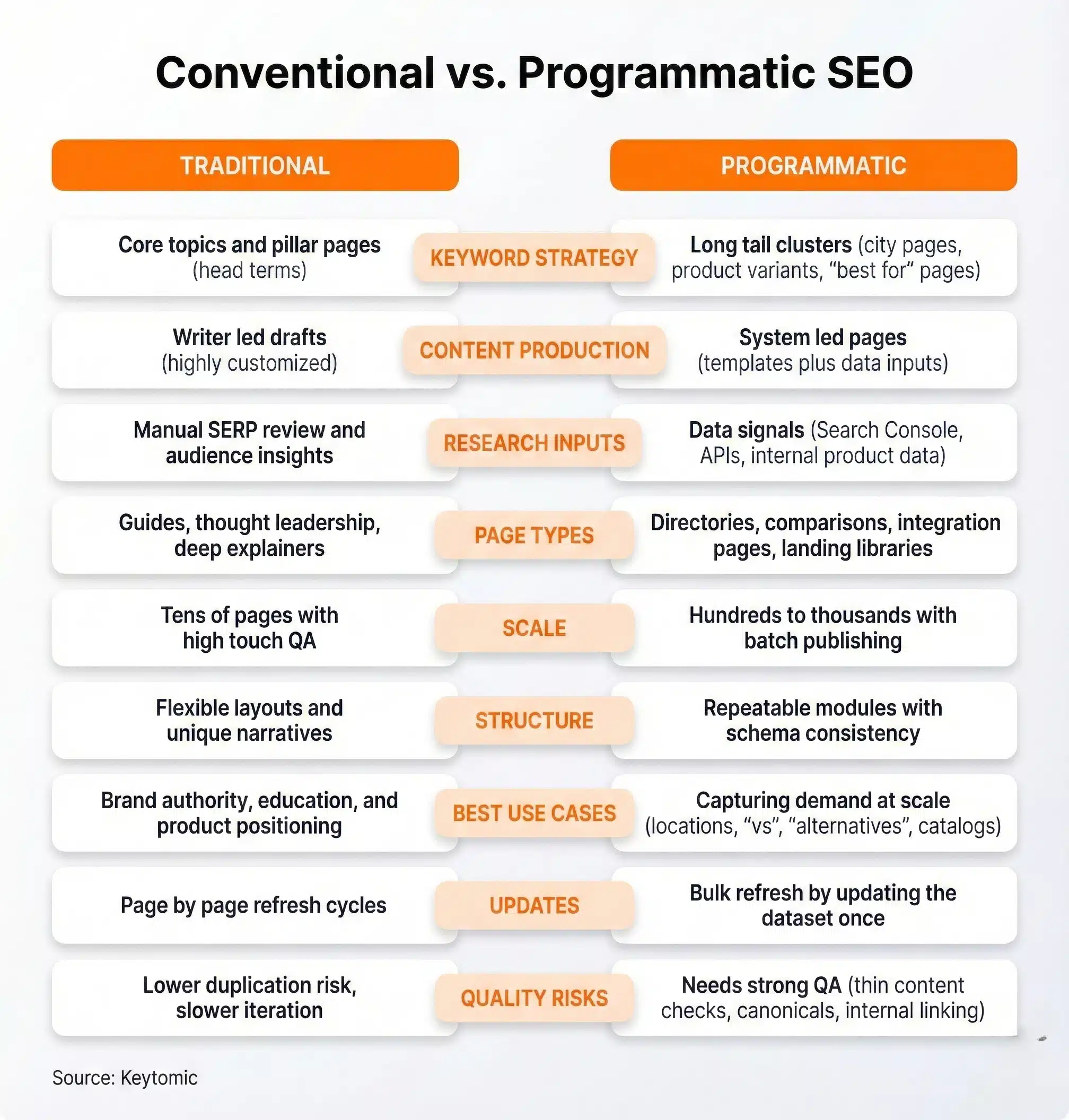
The difference between regular SEO and programmatic SEO is the difference between an artisan and a factory. Both can produce high-quality outcomes, but the production model is fundamentally different.
Regular SEO (The Artisan Model)
In traditional SEO, the relationship between effort and output is linear (1:1). A writer researches one topic, drafts one outline, and writes one unique article.
This approach is necessary for thought leadership, opinion pieces, and complex topics where the “answer” requires nuance and narrative, like “How to negotiate a salary” or “The future of AI.” Here, the value comes from the unique voice and expert perspective.
Programmatic SEO (The Industrial Model)
In programmatic SEO, the relationship is exponential (1:Many). Instead of writing content, you engineer it. You spend 50 hours building a database and a template, which then generates 5,000 pages.
The value doesn’t come from a unique narrative on every page; it comes from structured, accurate data presented exactly when a user needs it. It answers queries that follow a strict pattern, such as “weather in [city]” or “[software] vs [competitor] pricing.“
The Key Distinction: Regular SEO wins on depth and persuasion. Programmatic SEO wins on breadth and immediate utility.(Sources: Backlinko)
The Content Team Decision Matrix
Not all content ideas deserve the programmatic treatment. In fact, most don’t. You need a rigorous way to filter ideas before you waste sprint time building datasets.
We use a scoring system to evaluate potential patterns. Score each dimension from 1 to 5, then multiply them to get a priority score.
pSEO Pattern Scoring Table
| Content Type Pattern | Data Availability (1-5) | Search Demand (1-5) | Value Differentiation (1-5) | Total Score | Priority |
| [Product] + [Integration] Guides | 5 (API data usually public) | 4 (Strong high-intent) | 5 (Highly differentiated workflows) | 100 | High |
| [Tool] vs [Competitor] Comparisons | 4 (Internal + public data) | 5 (Proven volume) | 4 (Unique benchmarks possible) | 80 | High |
| [Feature] + [Template/Checklist] | 4 (Structured content) | 4 (Utility-driven) | 4 (Tool-augmented) | 64 | High |
| [Industry] + [Use Case] Guides | 3 (Requires expert input) | 4 (Solid demand) | 3 (Depends on depth) | 36 | Medium |
| [City/Region] + [Service] Pages | 5 (Address data available) | 3 (Local intent varies) | 2 (Often commoditized/thin) | 30 | Low |
The Golden Rule: If you score low on “Value Differentiation,” kill the project. It doesn’t matter how much data you have; if every page looks the same to the user, Google will eventually de-index them as “Crawled – currently not indexed.”
How to get started with programmatic SEO
Launching a programmatic project requires a shift in mindset from “writing” to “product management.” Follow these five steps to build a system that scales safely.
1. Find keywords that scale
You aren’t looking for a single keyword; you are looking for a head term and a modifier. The modifier is the variable that changes. Start by analyzing your broad topics and asking: “Can this be multiplied?”
- Bad: “How to do accounting” (One customized answer).
- Good: “Accounting laws for [Industry]” or “Sales tax rates in [State].” Use keyword research tools to validate that the pattern exists. If you see search volume for “sales tax in Texas,” check if it also exists for “sales tax in Florida.” If the volume repeats across the variable, you have a candidate.
2. Check search intent
Scale is useless if the intent is wrong. Google the first 5-10 variations of your keyword list. What shows up? If the results are 2,000-word opinionated blog posts, do not use pSEO.
Users want nuance. If the results are tables, lists, directories, or quick stats, do use pSEO. Users want facts. Your goal is to ensure that a templated page can actually satisfy the user. If the user needs a human’s empathy or a complex argument, a template will fail.
3. Find relevant data
This is your biggest bottleneck. You need a “source of truth.”
- Internal Data: This is the best moat. If you are Spotify, you have unique listening data. If you are a marketplace, you have inventory data.
- Public Data: Government datasets, Census bureaus, or APIs (like weather or stock markets).
- Scraped/Aggregated Data: Collecting data from across the web. (Proceed with caution regarding copyright). Structure this data into a clean CSV or database (like Airtable or Postgres). Every column in your database will eventually become a dynamic field on your page.
4. Build your pages
Now you connect the database to the design. You need a tool that can read your spreadsheet and output URLs.
- No-Code Tools: Platforms like Webflow CMS, Softr, or WordPress plugins (WP All Import) are great for non-technical teams.
- Custom Build: For larger sites (10k+ pages), engineering teams usually build a Next.js or React frontend that queries the database dynamically. Design your template with conditional visibility. If a row in your database lacks an image, ensure the template hides the image block rather than showing a broken icon.
5. Publish content to your website
Do not publish 10,000 pages on Day 1. This is a “spam signal” to search engines. Start with a pilot batch of 50 pages. Submit them to Google Search Console and monitor for “Crawl Budget” issues.
Check if they are being indexed or categorized as “Discovered – currently not indexed.” Once the pilot batch proves its quality (getting impressions and clicks), roll out the rest in cohorts (e.g., 500 pages per week).
Examples of Programmatic SEO in Action
Here are three industry-standard examples of brands that have mastered this operating model.
1. Zapier (B2B SaaS)
- URL:
zapier.com/apps - Estimated pages: 70,000+
- Estimated monthly organic traffic: 6M+
Brand Strategy: Zapier is the gold standard for B2B programmatic SEO. Their product connects apps, so their search opportunity is naturally combinatorial.
They built a “landing page engine” that automatically generates a page for every possible connection between two apps (e.g., “Connect Gmail to Slack”). Their strategy relies on intent capture at the bottom of the funnel.
When a user searches “Google Sheets to Trello integration,” they aren’t looking for a blog post; they are looking for a solution. Zapier’s template dynamically pulls in the specific “Triggers” and “Actions” available for that pair, instantly proving they can solve the problem.
2. TripAdvisor (Travel & Aggregation)
- URL:
tripadvisor.com/Hotels - Estimated pages: 10M+
- Estimated monthly organic traffic: 150M+
Brand Strategy: TripAdvisor dominates by aggregating user-generated content (UGC) into location-based templates.
Their pattern is simple: [Hotel/Restaurant/Thing to do] + in + [City]. Because they own the proprietary review data, their pages are impossible to replicate with generic AI content. Their strategy focuses on freshness and volume.
As soon as a user writes a new review, the page updates, signaling to Google that the content is alive. They use internal linking clusters (breadcrumbs like World > US > New York > NYC Hotels) to ensure crawlability across millions of URLs.
3. G2 (Software Reviews)
- URL:
g2.com/compare - Estimated pages: 50,000+
- Estimated monthly organic traffic: 3M+
Brand Strategy: G2 targets the high-stakes “comparison” intent found in B2B buying cycles. Their pattern focuses on [Software A] vs [Software B]. Their operational strength is structured data visualization.
Instead of writing long paragraphs comparing two tools, they use a standard comparison grid template that pulls ratings for “Ease of Use,” “Support,” and “Price” from their database. This allows users to scan the difference in seconds.
By letting vendors update their own profiles, G2 ensures their dataset (and therefore their programmatic pages) remains accurate without a massive internal content team.
Implementing pSEO: Industries and URL Structures
Programmatic SEO isn’t just for travel sites (e.g., TripAdvisor) or aggregators (e.g., Yelp). B2B and SaaS teams are now the heavy hitters.
Here is how successful teams structure their URLs and data:
1. B2B SaaS (Integrations)
- The Intent: Users want to know how two specific tools talk to each other.
- The Pattern:
{App Name} + {App Name} Integration - URL Structure:
example.com/integrations/slack-to-salesforce - Required Data: Triggers, Actions, API limits, Authentication methods.
- Differentiation: Don’t just list the integration. Show the specific triggers available for that pair.
2. FinTech (Comparisons)
- The Intent: Users comparing fees, limits, and speed.
- The Pattern:
{Competitor} vs {Your Brand} feesor{Competitor A} vs {Competitor B} - URL Structure:
example.com/compare/transferwise-vs-revolut - Required Data: Exchange rates, transfer speeds, fee percentages, supported countries.
- Differentiation: A live calculator widget on the page comparing the cost of sending $1,000.
3. Real Estate / PropTech
- The Intent: Hyper-local market data.
- The Pattern:
Homes for sale in {Neighborhood} with {Feature} - URL Structure:
example.com/buy/austin/downtown/condos-with-pool - Required Data: Median price, days on market, school ratings, specific listing count.
- Differentiation: Automated “Market Heatmap” block that only appears if you have enough data points.
20% of mobile queries are now voice searches, which skew heavily toward the natural language questions that well-structured pSEO answers best.(Source: HubSpot)
Template Design: The “Anti-Duplicate” Rules
If you remember one thing, remember this: variation is not a synonym spinner. It is structure, evidence, and intent fit.
Google’s guidance and spam policies make the core risk obvious. If you produce a large number of pages with little to no original value, you are stepping into scaled content abuse territory. (Google for Developers)
Rule 1: Conditional Logic is King
Don’t build one static template. Build a template that adapts based on the data.
- Bad: A “Pros and Cons” section that is hardcoded for every page.
- Good: A logic rule:
IF {integration_has_native_api} = TRUE, THEN show "API Configuration Block", ELSE show "Zapier Workaround Block".
Rule 2: The “Three Second Test”
If someone opens three random pages from your programmatic batch in three tabs, can they immediately see:
- Different data points in the hero section?
- Different distinct steps in the “How-to” section?
- Different recommended “Best for” scenarios?If the answer is no, your template is too uniform. You are building zombie pages.
Rule 3: Add “Scenario-Based” Usefulness
Content teams win when pages include realistic scenarios. Don’t just say “It integrates.” Say:
- “For small teams: Use the free tier.”
- “For enterprise: Use the SSO configuration.”These scenarios create differentiation and help readers self-select.
Dataset Readiness Checklist
Garbage in, garbage out. Your output is only as good as your spreadsheet (or database).
| Check | Question to Ask | Why it matters |
| Coverage | Do you have 80%+ field completion for your first 50 records? | Empty fields break template logic and look broken to users. |
| Normalization | Is “USA”, “U.S.”, and “United States” standardized to “US”? | Inconsistent data creates messy headings and broken filters. |
| Freshness | Which fields change monthly? (e.g., Pricing) | You need a plan to update this programmatically, or your pages will rot. |
| Uniqueness | Do you have at least 3 unique data points per record that no one else has? | This is your “moat.” If your data is public, your page is a commodity. |
Indexation Control and Rollout
Stop trying to index everything immediately. This is the rookie mistake that kills domain authority.
The “Tiered Indexing” Strategy
- Tier 1 (High Priority): Pages with perfect data, high search volume, and strong unique value. -> index, follow
- Tier 2 (Long Tail): Pages with decent data but low volume. -> index, follow (but monitor crawl stats)
- Tier 3 (Thin Data): Combinations where you lack specific data points. -> noindex, follow (Let users find them via internal search, but keep them out of Google).
Your First 30 Days Rollout Plan
If you want this to work, start smaller than your ambition. Scale comes after proof.
- Week 1: Pick one pattern from the decision matrix (Score 60+). Write a one-page “spec.”
- Week 2: Build the dataset. Normalize every single field.
- Week 3: Build the template with conditional blocks. If a field is missing, the block disappears.
- Week 4: Generate 25 pages. Manually QA every single one.
- Week 5: Publish the 25 pages. Submit to Search Console. Wait.
- Week 6: Iterate based on impression data. Then generate the next 500.
When to avoid programmatic SEO?
Programmatic SEO is a powerful hammer, but not everything is a nail. Misusing this tactic is the fastest way to get your site penalized for “mass-produced low-quality content.”
Avoid pSEO when the topic requires empathy or high-risk advice (YMYL).
If you are writing about medical symptoms, legal defense strategies, or personal finance advice, users need trust and specific context.
A templated page saying “The best divorce lawyer in [Town] is [Name]” feels robotic and untrustworthy. Google holds “Your Money or Your Life” (YMYL) topics to a higher standard of E-E-A-T (Experience, Expertise, Authoritativeness, and Trustworthiness) that generated pages rarely meet.
Avoid pSEO when you lack unique data.
If your dataset is just a scrape of Wikipedia or the same info found on ten other directories, you add no value to the web. Google calls this “Doorway Content.” If you cannot display a data point, an insight, or a utility that is unique to your page, stick to manual content creation.
Avoid pSEO when the Total Addressable Market (TAM) is tiny.
Don’t build an engineering pipeline to generate 500 pages if the total search volume for all those keywords combined is only 100 visits a month. The technical debt of maintaining a pSEO system is high; ensure the traffic reward justifies the build cost.
Where Keytomic fits into programmatic SEO for content teams
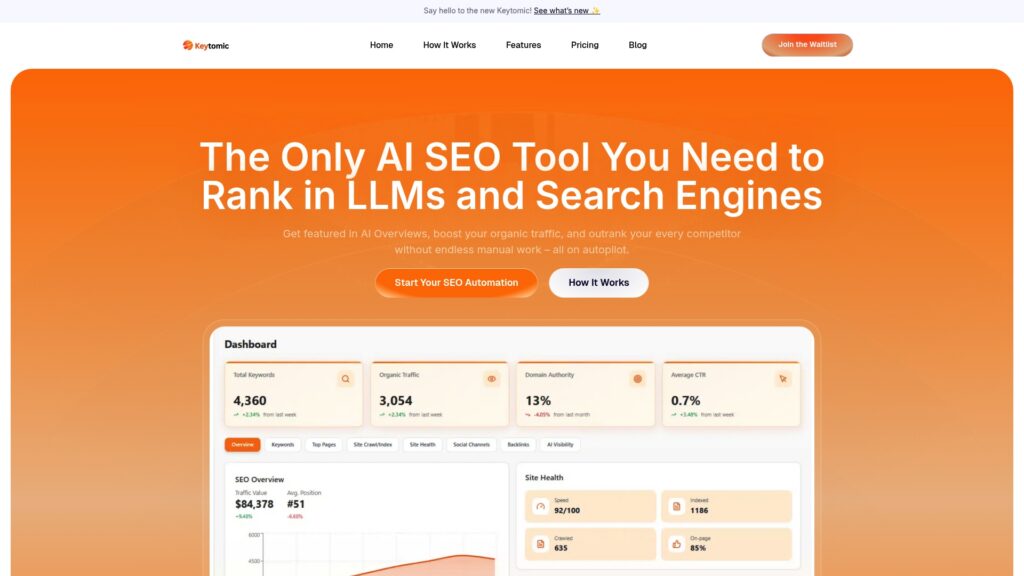
Keytomic is an all-in-one SEO engine, which is best used when a content team wants programmatic SEO to run as a system instead of a one-off build.
It can help teams move from “we have a template idea” to “we have a repeatable workflow” by supporting planning, on-page checks, and scalable publishing routines. The best fit is for teams creating many pages that need consistent QA and ongoing improvements, not for teams trying to mass-publish thin variants.
If your goal is to scale high-intent pages with clear structure, internal linking, and quality gates, Keytomic fits naturally into that operating model while keeping the content team in control of what gets published and indexed.
Getting started with programmatic SEO
Programmatic SEO is not about producing more pages. It is about producing the right pages repeatedly.
Start with one template that naturally creates unique value. Build the dataset like a product spec. Publish a small batch and review it like a real user would.
Then scale only after your template proves it can stay useful and distinct, because that is the safest path on the right side of Google’s scaled content abuse policy.
If you want a simple next step, pick one page type, map its blocks, and draft the first ten variants today. Which template will you ship first this week?
Start Your Keytomic Trial Today!
Don’t rely on guesswork and outdated SEO strategies. Let Keytomic automate your SEO workflows so you can focus on what matters most — your brand.
Cancel Anytime. 14-Day Money Back Guarantee.

FAQ
What is pSEO marketing?
pSEO (Programmatic SEO) marketing is a strategy where marketing teams use code and data to create landing pages at scale to capture long-tail search traffic. Instead of writing one blog post at a time, you build a system that generates thousands of landing pages (like “Best CRM for Real Estate,” “Best CRM for Dentists,” etc.) to capture high-intent users right when they are looking for a solution.
How to do programmatic SEO?
The process generally follows four steps:
- Find a pattern: Identify a keyword structure people search for (e.g., “X vs Y”).
- Gather Data: Collect a database of information that answers those queries (features, pricing, ratings).
- Build a Template: Design a page layout that pulls in that data dynamically.
- Publish & Govern: Generate the pages, check them for quality, and publish them with strict internal linking rules.
What is the difference between SEO and pSEO?
Standard SEO is artisanal; it’s like a chef cooking one custom meal at a time (hand-writing a blog post). pSEO is industrial; it’s like a factory production line that produces high-quality meals at scale using a mold (template) and ingredients (data).
- SEO: 1 input = 1 output.
- pSEO: 1 input (template) + Data = 1,000 outputs.
What are the 4 types of SEO?
In the context of a holistic strategy, pSEO fits into a broader mix:
- On-Page SEO: Optimizing individual pages (content, keywords, tags).
- Off-Page SEO: Building authority via backlinks and PR.
- Technical SEO: Ensuring the site is crawlable and fast (critical for pSEO).
- Local SEO: Optimizing for location-based visibility (often a target of pSEO campaigns).
Is programmatic SEO allowed by Google?
Yes, automation is not banned. The risk is scaled content abuse, which focuses on mass pages created mainly to manipulate rankings rather than help users. If your pages help the user, the method of creation doesn’t matter. (Google for Developers)
Can AI write programmatic SEO pages safely?
AI can help draft blocks (like intros or summaries), but you still need hard data validation. Relying 100% on AI for the whole page usually results in “hallucinations” or generic fluff that fails the specific intent of the user. Use AI to assist, not to pilot.
Related Articles: