 WordPress
 Shopify
 Webflow
 Framer
 Wix
 Squarespace
 Lovable

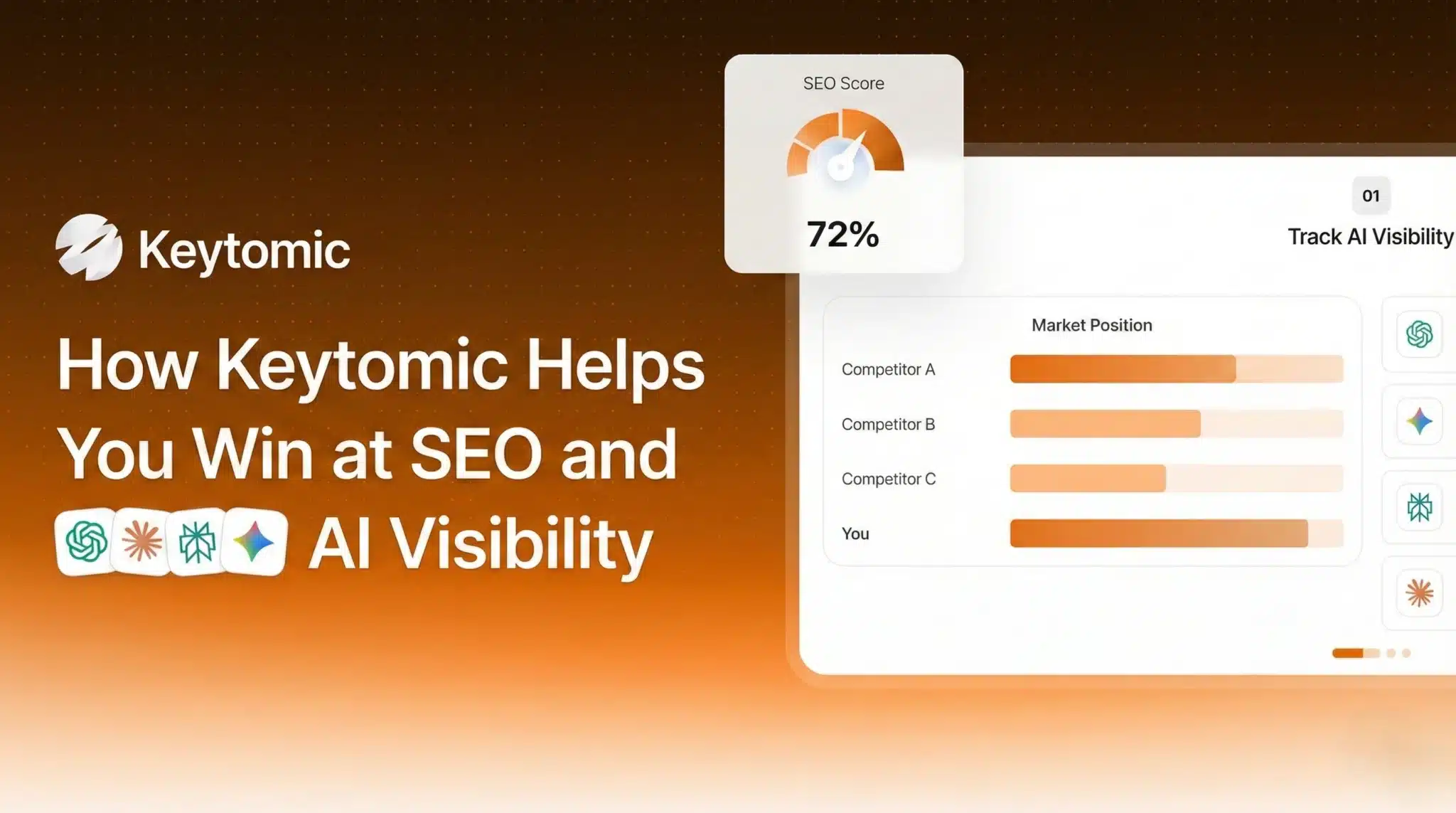
Your content team publishes 12 articles this month. Keytomic makes this possible at scale. Research takes 8 hours per piece. Writing takes another 6 hours. Editing, optimizing, publishing, and indexing add 4 more hours. That's 18 hours per article, or 216 hours total this month for your team.
If this applies to your team, SEO automation software for SEO teams walks through how Keytomic fits into that workflow.
Now imagine this: The same 12 articles, researched, written, optimized, published, and indexed automatically. Your team spends 2-3 hours reviewing each piece instead of 18 hours creating it from scratch. That's 36 hours total this month versus 216 hours.
That's not a dream. That's what happens when 1,200+ founders and marketers switched to Keytomic as their all-in-one AI SEO engine. If you are still comparing options, start with our guide to SEO automation software.
This guide breaks down exactly how Keytomic helps different teams win at SEO, which features replace your current toolkit, and why companies are saving $18,701 per month (97% cost reduction) while increasing content output by 300%. Plans and limits are on the Keytomic pricing page.
Key Takeaways
Keytomic automates your entire SEO workflow from keyword research to indexed content in one platform.
Teams save 120+ hours per month on SEO and content production.
The platform replaces 5-8 separate tools costing $800-3,000/month combined.
Content gets indexed 70% faster with built-in auto-indexing (3-14 days vs 7-30 days).
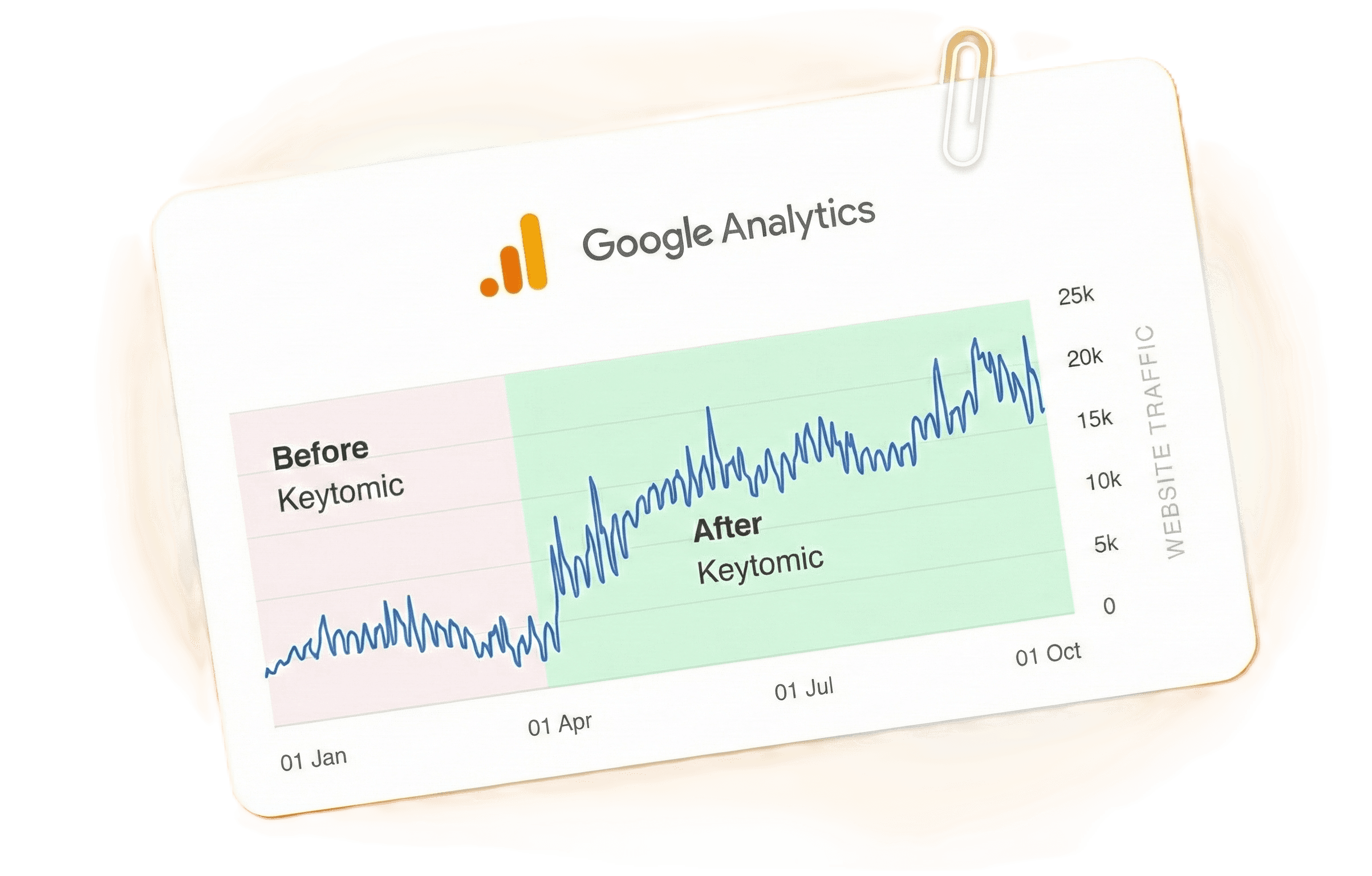
Businesses see 200-300% organic traffic increases within 2-3 months.
Works for founders, marketing teams, agencies, and content operations at scale.
Optimizes for both traditional search engines AND AI platforms (ChatGPT, Perplexity, Gemini).
What Makes Keytomic Different: The AI SEO Engine Advantage
Before we dive into specific features and use cases, let's understand what "AI SEO engine" actually means and why it matters.
Most SEO tools give you data. They show you keywords, competitor analysis, site audits, and optimization suggestions. But then what? You still need to manually research, write, optimize, publish, and pray Google finds your content eventually.
Keytomic takes a fundamentally different approach. It's not an SEO tool that assists you. It's an SEO engine that executes for you. It also runs checks such as a backlink profile audit.
Here's the shift: Traditional SEO requires 9-15 manual steps to get one article from idea to indexed. Research keywords. Analyze search intent. Study competitors. Create outlines. Write content. Optimize for SEO. Generate images. Format properly. Publish to CMS. Submit to Search Console. Track rankings. Fix technical issues. Update regularly. Pray it works.
Keytomic compresses that into 3 steps: Approve your calendar. Review drafted content (optional). Watch it auto-publish and index.
The Traditional SEO Stack vs Keytomic
Here's what most marketing teams are currently juggling:
| Traditional SEO Stack | Monthly Cost | Primary Function | What You Still Do Manually |
|---|---|---|---|
| Ahrefs/Semrush | $200-800 | Keyword research, competitor analysis | Everything after research |
| Surfer SEO/Clearscope | $100-400 | Content optimization | Writing, publishing, indexing |
| Jasper/Copy.ai | $50-200 | AI content generation | Optimization, publishing, indexing |
| WordPress plugins | $50-150 | On-page SEO, schema | Content creation, strategy |
| Screaming Frog/Sitebulb | $150-300 | Technical audits | Fixing issues, ongoing monitoring |
| IndexNow/Manual submission | $0-100 | Indexing assistance | Manual submission, tracking |
| Total Cost | $550-1,950/month | Scattered functions | Everything between tools |
Plus: 15-20 hours per week of team time jumping between platforms, copy-pasting data, and manually executing each step. At $75/hour average loaded cost, that's $4,500-6,000 per month in labor just on tool management and execution.
Keytomic replaces this entire stack with one unified workflow for $99/month (or $79/month annually).
Let that sink in. You're potentially saving $5,451-$7,851 per month while actually increasing output quality and quantity.
The Complete Keytomic Platform: Every Module Explained
Let's break down each module and how it transforms your SEO workflow.
Module 1: Advanced Keyword Research & Sweet Spot Finder
What it does: Analyzes your industry, competitors, and search opportunities to find high-intent keywords with real ranking potential.
The traditional way: Open Ahrefs. Export 500 keywords. Import to spreadsheet. Manually filter by search volume. Check keyword difficulty. Analyze search intent. Study competitor pages. Build keyword clusters. Takes 6-8 hours for one content batch.
The Keytomic way: Connect your website. The platform automatically identifies "sweet spot" keywords where search intent, volume, and difficulty align. You get a prioritized list with exact ranking opportunities. Takes 10 minutes to review and approve.
What makes it different: The sweet spot methodology focuses on keywords you can actually rank for rather than vanity metrics. A keyword with 2,000 monthly searches and KD 35 beats one with 10,000 searches and KD 75 if you're a newer domain.
Key features:
Intent mapping (informational, commercial, transactional, navigational)
Competitor keyword gap analysis
Search volume trends (not just current data)
Keyword clustering for topic authority
SERP feature identification (People Also Ask, AI Overviews, Featured Snippets)
A dental practice client wanted to rank for "dental implants" (KD 87, dominated by huge brands). Keytomic identified "dental implant cost in [city]" (KD 32) and "are dental implants worth it" (KD 28) as better opportunities. Both ranked page 1 within 4 months. Combined, they drove 340 monthly organic sessions versus likely zero from the impossible KD 87 keyword.
Learn more: What Is Keyword Difficulty (KD) And How To Actually Use It
Module 2: 30-Day Rolling Content Calendar
What it does: Generates and maintains a continuously updated content calendar with high-intent topics mapped to your business goals.
The traditional way: Quarterly content planning meetings. Spreadsheet management. Constant calendar gaps. Last-minute scrambling for topic ideas. Calendars go stale within weeks.
The Keytomic way: Your calendar auto-generates with 30 days of topics always in queue. As articles publish, new ones automatically fill the pipeline. Your calendar never goes empty.
What makes it different: This isn't a static calendar you build once. It's a rolling system that adapts as you publish. The platform learns which topics perform best and suggests similar high-potential content.
Key features:
Auto-replenishment (calendar never goes empty)
Topic clustering for authority building
Seasonal opportunity detection
Content gap identification
Publishing schedule optimization (best days/times based on your audience)
Industry Insight
According to Content Marketing Institute, marketing teams using automated workflows produce 41% more content with the same team size compared to manual processes. Keytomic's rolling calendar makes this possible.
Related reading: How to Auto-Schedule Publishing with a Content Calendar Template
Module 3: E-E-A-T Optimized Content Generation
What it does: Creates SEO-ready content that demonstrates Experience, Expertise, Authoritativeness, and Trustworthiness while targeting your specific keywords and search intent.
The traditional way: Brief freelance writers. Wait 7-10 days. Get generic content. Spend 3-4 hours editing. Still lacks expertise signals. Publish and hope Google doesn't penalize it for thin content.
The Keytomic way: Platform generates comprehensive drafts (1,500-7,000 words) with proper heading structure, FAQ sections, data-backed claims, and expertise signals built in. Review in 30-45 minutes, customize as needed, approve.
What makes it different: Not just AI content generation. Every piece includes:
Direct answer paragraphs (40-60 words, citation-ready for AI platforms)
FAQ sections with schema-ready formatting
Statistics with source citations (5-10 per article)
Comparison tables where relevant
Entity optimization (proper brand mentions, semantic relationships)
Internal linking suggestions to build topical authority
Key features:
Custom tone and style matching your brand voice
Industry-specific content customization (we covered SEO for lawyers and SEO for dentists comprehensively)
Real-time SEO scoring during generation
Plagiarism and AI detection avoidance
Unlimited AI rewrites and editing
Industry Insight
Semrush's 2025 AI SEO report shows 93% of marketers review AI-generated content before publishing. Keytomic's generation already includes the elements most teams manually add during editing, cutting review time by 70-80%.
Module 4: Brand Image Generation with AI
What it does: Creates branded, SEO-optimized images that match your visual style, color palette, and brand guidelines automatically.
The traditional way: Hire designer. Brief project. Wait for mockups. Provide feedback. Wait for revisions. Or use generic stock photos everyone else uses. Or create them yourself in Canva spending 45-60 minutes per image.
The Keytomic way: Platform generates featured images, in-content visuals, and social previews automatically based on your brand colors (like #FF7A00 orange for Keytomic) and style preferences. Images are SEO-optimized with proper alt text and file naming.
What makes it different: Not random AI-generated art. Branded, on-style visuals that look like your design team created them. Every image includes alt text optimized for accessibility and SEO.
Key features:
Brand color palette integration
Consistent style across all content
Automatic alt text generation
Proper file naming for SEO
Featured image + in-content visuals
Social media preview optimization
Cost savings: Design services cost $50-150 per image. At 12 articles/month with 3 images each, that's $1,800-5,400/month in design costs eliminated.
Module 5: Seamless CMS Integrations & One-Click Publishing
What it does: Connects directly to your content management system (WordPress, Shopify, HubSpot, Webflow, Wix, Drupal, Sanity, Ghost, Framer) for instant publishing.
The traditional way: Copy content from Google Docs. Paste into CMS. Fix formatting breaks. Upload images separately. Add alt text manually. Set categories and tags. Configure SEO settings. Preview. Find issues. Fix. Repeat. Takes 30-45 minutes per article.
The Keytomic way: Click "Publish" or enable auto-publish. Content appears on your site with images, formatting, internal links, schema markup, and SEO settings already configured. Takes 30 seconds.
What makes it different: True one-click publishing, not just "content ready to copy-paste." The platform maintains your site's design, category structure, and style automatically.
Key features:
One-click authentication (OAuth for supported platforms)
Two-way sync (edit in Keytomic or CMS, stays synchronized)
Automatic schema markup injection
Internal linking based on your existing content
Category and tag auto-assignment
Custom field population (for advanced WordPress setups)
Time savings: 30-45 minutes per article in manual publishing work eliminated. At 12 articles/month, that's 6-9 hours monthly your team gets back.
Industry Insight
DemandSage research on AI-driven SEO showed companies implementing comprehensive automation strategies saw 45% boosts in organic traffic and 38% increases in e-commerce conversions.
Module 6: Instant Auto-Indexing Tool
What it does: Automatically submits every published article to Google Search Console and Bing Webmaster Tools for immediate indexing, bypassing the normal crawl wait.
The traditional way: Publish article. Wait 7-30 days for Google to crawl. Maybe manually submit URL in Search Console. Still wait 5-14 days. Check indexing status manually. Find half your content not indexed after months.
The Keytomic way: Every article auto-submits to search engines within minutes of publishing. Indexing happens 70% faster (3-14 days vs 7-30 days). You get notifications when pages are indexed.
What makes it different: Indexing is treated as part of the publishing workflow, not an afterthought. The platform monitors indexing status and resubmits if needed.
Key features:
Automatic Search Console submission
Bing Webmaster Tools integration
IndexNow protocol support
Indexing status tracking dashboard
Automatic resubmission for failed attempts
Sitemap auto-update and submission
Critical stat: Pew Research Center found pages submitted through Search Console index 70% faster than those discovered through regular crawling. For time-sensitive content, this speed matters enormously.
Deep dive: Best instant auto-indexing tool options for rapid visibility
Module 7: AI Visibility Tracker & GEO Optimization
What it does: Tracks your brand mentions and citations across AI platforms (ChatGPT, Perplexity, Gemini, Claude) and optimizes content for Generative Engine Optimization (GEO).
The traditional way: Manually test queries in ChatGPT. Hope your brand gets mentioned. Have no idea if you're cited or not. Watch competitors get AI visibility while you're invisible. Struggle to understand what AI optimization even means.
The Keytomic way: Dashboard shows exactly where your brand appears in AI-generated responses. Platform automatically structures content for maximum AI citation likelihood with FAQ schemas, direct answers, and entity optimization.
What makes it different: You're not just optimizing for Google anymore. 58% of Google searches now display AI Overviews, and ChatGPT serves 400 million weekly users. Keytomic ensures you're visible everywhere people search, not just traditional blue links.
Key features:
Multi-platform citation tracking (ChatGPT, Perplexity, Gemini, Claude)
Share of AI voice measurement (your mentions vs competitors)
AI referral traffic tracking
Automatic GEO optimization (FAQ schemas, direct answers, entity clarity)
AI Overviews appearance monitoring
Industry Insight
BrightEdge analyzed over 1 million AI-generated responses and found 40% of citations come from websites ranking in Google's top 10 results. But here's the opportunity: 28% of ChatGPT's most-cited pages have zero organic visibility in Google. Both channels matter, and Keytomic optimizes for both.
Complete guide: Complete Guide to GEO: Generative Engine Optimization
Also read: How to Rank in AI Searches and AI SEO: Complete Guide
Module 8: SEO Health Audit & Technical Crawler
What it does: Continuously monitors your site for technical SEO issues, provides prioritized fix recommendations, and tracks improvements over time.
The traditional way: Run Screaming Frog monthly. Export 10,000 rows of data. Manually identify critical issues. Create tickets for dev team. Hope issues get fixed. Re-audit to verify. Rinse and repeat.
The Keytomic way: Automated crawls detect issues like broken links, missing metadata, duplicate content, schema errors, and crawlability problems. You get clear, prioritized recommendations with severity scoring. Track fixes automatically.
What makes it different: Not just issue detection. The platform explains why each issue matters and how it impacts rankings, in language non-technical marketers understand. No PhD in technical SEO required.
Key features:
Automated site crawling (weekly, monthly, or on-demand)
Prioritized issue list (critical, high, medium, low)
Core Web Vitals monitoring
Schema markup validation
Mobile usability checks
Page speed scoring
Indexability verification
Industry Insight
Backlinko research on ranking factors shows technical SEO foundations (site speed, mobile-friendliness, HTTPS, proper indexing) remain critical for rankings. You can't win on content alone if technical issues block Google from crawling and indexing properly.
Cost comparison: Tools like Screaming Frog Pro ($200/year) and Sitebulb ($300/year) handle technical audits but require significant expertise to interpret. Keytomic includes technical monitoring with plain-English recommendations as part of the platform.
Module 9: AI Copilot for Content Editing
What it does: Provides instant content refinement and rewriting without leaving the platform. Need to adjust tone? Expand a section? Simplify complex paragraphs? The AI Copilot handles it in seconds.
The traditional way: Open article in CMS editor. Manually rewrite sections. Copy paragraphs to ChatGPT for rewrites. Copy back. Format. Save. Preview. Find new issues. Repeat.
The Keytomic way: Highlight any section. Tell the AI Copilot what you need. Get instant rewrites without leaving the editor. Apply changes in one click.
What makes it different: Context-aware editing that maintains your brand voice and SEO optimization while refining content. Not generic AI rewrites that lose your message.
Key features:
Unlimited AI rewrites (no additional costs)
Tone adjustment (professional, casual, technical, friendly)
Length modification (expand or condense sections)
Simplification (reduce reading level)
SEO preservation (maintains keyword density and structure)
Multi-language support
Time savings: Traditional editing: 2-3 hours per article. With AI Copilot: 30-45 minutes per article. That's 60-75% time reduction on content refinement.
Module 10: Programmatic SEO for Scale
What it does: Enables creation of hundreds or thousands of templated pages that target long-tail keyword variations systematically.
The traditional way: Manually create individual pages for every location, product, or service variation. Takes months. Requires massive team. Most companies just don't do it because it's too expensive.
The Keytomic way: Build one template. Define your data sources (locations, products, services). Generate hundreds of unique, SEO-optimized pages automatically. Each page has unique content, proper internal linking, and schema markup.
What makes it different: Quality-first programmatic SEO. Not thin, templated spam. Each page includes unique value while maintaining efficiency at scale.
Key features:
Template-based page generation
Data source integration (CSVs, databases, APIs)
Unique content per page (not duplicate content)
Automatic internal linking between related pages
Schema markup at scale
Bulk indexing submission
Use cases:
Local businesses: Generate location pages for every service area
E-commerce: Create category + location pages ("buy X in Y")
SaaS: Build comparison pages for every competitor combination
Agencies: Deploy multi-location service pages for clients
Complete guide: Full Guide to Programmatic SEO for Content Teams in 2025
Start Your Keytomic Trial Today!
Don't rely on guesswork and outdated SEO strategies. Let Keytomic automate your SEO workflows so you can focus on what matters most; your brand.
Generate Your 30-Day CalendarBook Your Demo
Cancel Anytime. 14-Day Money Back Guarantee.
How Different Teams Win with Keytomic: ICP-Specific Use Cases
Different teams have different SEO challenges. Here's exactly how each type of user benefits from Keytomic.
Solo Founders & Bootstrapped Startups
The challenge: You're wearing 12 hats. You know SEO matters, but you can't spend 20 hours per week on content. You can't afford $3,000-5,000/month agency retainers or full-time content writers at $60,000-80,000/year.
The Keytomic win:
Time savings: From 20 hours/week on SEO down to 3-4 hours/week reviewing and approving content. That's 16+ hours weekly back in your schedule for product development, sales, or customer success.
Cost savings: Traditional options: Agency retainer ($3,000-5,000/month), freelance writer ($500-1,500/month), plus tools ($300-500/month).
Total: $3,800-7,000/month. Keytomic: $99/month. Savings: $3,701-6,901/month or $44,412-82,812/year.
What you get: 30 SEO-ready articles per month, keyword research, content generation, branded images, publishing, and indexing all automated. You focus on strategy and customization (2-3 hours per week) instead of execution.
Perfect for:
Technical founders who understand SEO value but lack bandwidth
Solo entrepreneurs running lean operations
Early-stage startups (pre-Series A) with limited resources
Indie hackers building in public
Start your 14-day trial today →
Small to Mid-Size Marketing Teams (2-10 people)
The challenge: Your team is stretched thin across paid ads, email marketing, social media, events, and content. SEO is important, but you can only afford one content marketer who's drowning in requests. You need to scale content output without proportional headcount growth.
The Keytomic win:
Team multiplier effect: One content marketer can manage 3-5x more output with Keytomic. Instead of creating 8-12 articles/month from scratch, they can review and refine 30-40 articles/month generated by the platform.
Cost avoidance: Hiring a second content marketer costs $60,000-80,000/year plus benefits (total: $75,000-100,000). Hiring a third costs the same. Keytomic: $1,188/year for same output increase. Savings: $73,812-98,812 in avoided hiring costs.
Quality improvement: Built-in SEO best practices, E-E-A-T signals, and GEO optimization mean content quality actually increases while quantity scales. You're not sacrificing quality for speed.
Workflow transformation:
Before Keytomic: 8 articles/month, 18 hours per article = 144 hours/month content production
With Keytomic: 30 articles/month, 2 hours review per article = 60 hours/month content production
Time saved: 84 hours/month or 1,008 hours/year
Additional capacity: Write thought leadership pieces, run original research, develop new content formats
Perfect for:
B2B SaaS marketing teams under 10 people
Mid-market companies with established brands
Growing startups (Series A-C) scaling content operations
E-commerce brands balancing product and content marketing
Tool stack replacement: Keytomic consolidates Ahrefs ($200/month), Surfer SEO ($100/month), Jasper ($50/month), design tools ($50/month), and indexing services ($50/month). Savings: $450/month or $5,400/year on tools alone, plus 84 hours/month in execution time.
Agencies Managing Multiple Clients
The challenge: Client #1 needs 10 articles this month. Client #2 needs 15. Client #3 needs 8. You promised them all by the 25th. Your writers are at capacity. You're considering hiring more, but that reduces margins. Client profitability is already tight at $3,000-5,000/month retainers with current headcount.
The Keytomic win:
Client capacity increase: Manage 3-5x more clients with the same team size. Reduce content production from 18 hours to 3 hours per article. Your team focuses on strategy, client communication, and campaign management instead of grinding out content.
Margin improvement: Agency economics transform. Before: $5,000 monthly retainer, 80 hours of production work at $75/hour loaded cost = $6,000 cost = -$1,000 loss. After: $5,000 retainer, 20 hours of work at $75/hour loaded cost = $1,500 cost = $3,500 profit. Margin improves from -20% to +70%.
White-label capabilities: Keytomic allows full white-labeling. Your clients never see "Keytomic." They see your agency brand. You maintain your agency's expertise positioning while leveraging automation behind the scenes.
Service expansion: With freed capacity, offer new services without hiring. Add technical SEO audits, AI optimization (GEO), programmatic SEO, or content distribution to increase per-client revenue.
Perfect for:
Content marketing agencies handling 5-20 clients
SEO agencies offering content as part of service mix
Digital marketing agencies with monthly retainer models
White-label content providers
ROI for agencies:
| Metric | Before Keytomic | With Keytomic | Improvement |
|---|---|---|---|
| Clients managed | 12 | 20 | +67% |
| Content producers needed | 6 | 2 | -67% |
| Hours per article | 18 | 3 | -83% |
| Monthly revenue | $48,000 | $80,000 | +67% |
| Monthly labor cost | $45,000 | $26,250 | -42% |
| Monthly profit | $3,000 | $53,750 | +1,692% |
Enterprise Marketing & Large Content Operations
The challenge: You publish 100+ articles per month across multiple brands, regions, or product lines. Managing freelance writers, editors, and approval workflows is a nightmare. Tool costs are $5,000-10,000/month. Coordinating across teams (content, SEO, product marketing, PR) creates bottlenecks. Content quality varies wildly between contributors.
The Keytomic win:
Process standardization: Every article follows the same SEO best practices, brand guidelines, and quality standards automatically. No more variance between writers. Consistent E-E-A-T signals across all content.
Workflow consolidation: Replace 5-8 different tools (keyword research, content optimization, creation, publishing, indexing, tracking) with one unified platform. Reduce training time for new hires. Simplify tech stack management.
Multi-brand management: Separate projects for each brand within one platform. Each maintains its own tone, style, calendar, and keyword strategy while your team manages everything from one dashboard.
Compliance and governance: Enterprise-grade controls for approval workflows, content review, and publication permissions. Legal and compliance teams can review before content goes live.
Cost optimization at scale:
| Component | Enterprise Manual Approach | With Keytomic | Annual Savings |
|---|---|---|---|
| SEO tools | $8,000/year | Included | $8,000 |
| Content tools | $6,000/year | Included | $6,000 |
| Freelance writers (100 articles/month) | $120,000/year | $0 | $120,000 |
| Editors (review all content) | $80,000/year | $40,000/year (review only) | $40,000 |
| Project management overhead | $45,000/year | $15,000/year | $30,000 |
| Total | $259,000/year | $56,188/year | $202,812/year |
Perfect for:
Enterprise brands with multiple product lines
Global companies managing multi-region content
Publishing companies with high content volume
Large e-commerce operations (1000+ products)
Custom enterprise plan includes:
Unlimited content calendars
Unlimited projects (brands, regions, products)
Unlimited keyword research
Unlimited team seats
Dedicated account management
Custom integrations and API access
SSO and advanced permissions
Request custom enterprise pricing →
Replacing Your Costly SEO Toolkit: Feature-by-Feature Comparison
Let's break down exactly which tools Keytomic replaces and how much you save.
| Tool Category | Annual Cost | Keytomic Replacement | Keytomic Annual Cost | Annual Savings |
|---|---|---|---|---|
| Keyword Research | $2,400-9,600 | Sweet Spot Finder | Included | $2,400-9,600 |
| Content Optimization | $1,200-4,800 | E-E-A-T Content Generation | Included | $1,200-4,800 |
| AI Content Generation | $600-2,400 | AI Content Engine | Included | $600-2,400 |
| Image Creation | $600-1,800 | Brand Image Generation | Included | $600-1,800 |
| Technical SEO Audit | $1,800-3,600 | SEO Health Audit & Crawler | Included | $1,800-3,600 |
| Indexing Services | $0-1,200 | Auto-Indexing Tool | Included | $0-1,200 |
| AI Visibility Tracking | $1,200-3,600 | AI Visibility Tracker | Included | $1,200-3,600 |
| Content Calendar Tool | $600-2,400 | 30-Day Rolling Calendar | Included | $600-2,400 |
| CMS Publishing Tool | $300-1,200 | 12+ CMS Integrations | Included | $300-1,200 |
| Total Tool Costs | $8,700-30,600/year | Keytomic All-in-One | $948-1,188/year | $7,752-29,412/year |
Plus labor savings: 84-180 hours/month in execution time saved. At $75/hour loaded cost: $75,600-162,000/year in team time redirected to strategic work.
Total annual value: $83,352-191,412 in combined tool and labor savings.
Real Results: What Teams Achieve with Keytomic
These outcomes come from documented platform metrics and customer feedback patterns.
Content output transformation
Teams consistently report moving from 8-12 articles/month to 30-40 articles/month with the same headcount. The shift happens because Keytomic eliminates the execution bottleneck. Strategy and review still require human judgment. Research, writing, optimization, publishing, and indexing don't.
What this means in practice:
A 2-person marketing team publishes what previously required a 6-person team
A solo founder maintains an active blog without sacrificing product development time
An agency doubles client capacity without hiring
Traffic growth timeline
Based on typical content compounding patterns:
Month 1-2: Setup, calendar generation, first articles published and indexed
Month 3-4: Initial rankings appear, long-tail keywords start driving traffic
Month 5-6: Content compounds, traffic accelerates, topical authority builds
Month 7-12: Significant organic traffic growth, 200-300% increases common for consistent publishers
The key variable: consistency. Teams that publish 20-30 articles/month see faster compounding than those publishing 8-10. Keytomic makes high-volume consistency achievable without proportional resource increases.
Cost reduction at different scales
Small team (2-5 people):
Tool consolidation savings: $400-600/month
Labor redirection value: $6,300-10,500/month
Total monthly value: $6,700-11,100/month
Keytomic cost: $99/month
ROI: 6,668-11,110%
Mid-size team (5-15 people):
Tool consolidation savings: $600-1,200/month
Labor redirection value: $10,500-22,500/month
Total monthly value: $11,100-23,700/month
Keytomic cost: $99-299/month
ROI: 3,700-23,900%
Agency (managing 10+ clients):
Increased client capacity value: $20,000-50,000/month
Tool consolidation savings: $800-2,000/month
Total monthly value: $20,800-52,000/month
Keytomic cost: $299-499/month
ROI: 4,160-17,400%
Implementation: Getting Started with Keytomic
The fastest path from sign-up to published, indexed content is straightforward.
Week 1: Setup and configuration
Day 1-2: Account setup
Connect your website domain. The platform immediately begins analyzing your existing content, identifying keyword opportunities, and understanding your niche.
Day 3-4: Brand configuration
Set your brand voice (professional, conversational, technical), color palette for image generation, and content guidelines. The more specific you are here, the better your generated content matches your brand.
Day 5-7: Calendar review
Your first 30-day content calendar generates automatically. Review the topics, adjust priorities, add or remove suggestions. Approve the calendar to begin content generation.
Week 2: First content batch
Your first articles generate within 24-48 hours of calendar approval. Review each piece (most teams spend 30-45 minutes per article). Make adjustments using the AI Copilot if needed. Approve for publishing.
Publishing setup: Connect your CMS (WordPress, Shopify, Webflow, etc.) using OAuth. Test with one article. Confirm formatting, images, and SEO settings look correct. Enable auto-publish or maintain manual approval workflow.
Week 3-4: Optimization and scaling
Review first indexing confirmations (most articles index within 3-14 days). Check Search Console for initial impressions data. Adjust keyword strategy based on early signals. Scale publishing frequency if content quality meets your standards.
Team workflow integration: Most teams settle into a weekly review rhythm. Monday: approve next week's topics. Wednesday: review generated drafts. Friday: confirm publishing queue. Total time commitment: 4-6 hours/week for 20-30 articles/month output.
Common Questions About Keytomic
Does Keytomic replace human content teams entirely?
No, and it's not designed to. Keytomic eliminates execution work (research, writing, optimization, publishing, indexing). It doesn't replace strategic thinking, subject matter expertise, customer interviews, original research, or relationship-driven content like executive bylines and thought leadership.
What changes: Your content team shifts from production to strategy. Instead of spending 80% of time creating content, they spend 80% of time improving content quality, developing new formats, and building content systems.
How does the content quality compare to human writers?
Keytomic generates content that meets SEO best practices by default. It includes proper structure, keyword optimization, E-E-A-T signals, and citation-ready direct answers. What it doesn't replicate: unique personal experiences, proprietary research, industry relationships, and distinctive voice that comes from deep subject matter expertise.
The optimal workflow: Use Keytomic to handle the foundational SEO content that drives organic discovery. Use your human team for flagship content pieces that build brand authority.
What happens to existing content?
Keytomic audits your existing content as part of setup. The platform identifies gaps, optimization opportunities, and internal linking improvements. You can update existing articles through the platform as well as create new ones.
How does Keytomic handle different industries?
The platform works across industries including SaaS, e-commerce, professional services, healthcare (with appropriate disclaimers), legal (with appropriate disclaimers), finance, real estate, and others. Industry-specific customization happens through brand profile setup and content guidelines configuration.
Regulated industries (healthcare, legal, financial) require additional human review before publishing to ensure compliance. The platform generates compliant-ready content, but final review responsibility remains with the publishing team.
What's the minimum commitment?
Keytomic offers monthly billing with no long-term contracts. You can cancel anytime. A 14-day money-back guarantee applies to initial subscriptions. Most teams see meaningful results within 60-90 days of consistent publishing.
Keytomic vs Individual Specialist Tools: When to Choose What
Keytomic isn't the right choice for every situation. Here's an honest comparison.
Choose Keytomic when:
You need end-to-end SEO automation (research → publish → index)
You're currently using 3+ separate SEO tools
Content production is a bottleneck for your team
You want to scale output without proportional headcount growth
You need both traditional SEO and AI visibility optimization
You're a founder, small team, or agency with resource constraints
Consider specialist tools when:
You need enterprise-grade link building (Keytomic doesn't do outreach)
Your primary need is advanced technical SEO consulting
You require custom enterprise integrations not on Keytomic's integration list
You have an existing content team at full capacity that just needs optimization tools
You're primarily focused on paid search rather than organic
The hybrid approach: Many teams use Keytomic for content execution and a specialist tool for specific functions like advanced link analysis (Ahrefs) or technical audits at enterprise scale (Screaming Frog). The key question: does Keytomic's automation value exceed the cost of maintaining multiple specialized tools?
For most teams publishing 10+ articles/month: yes.
Getting Maximum Value from Keytomic
Teams that see the best results share common patterns.
Publish consistently: The content compounding effect requires consistent publishing. 20-30 articles/month outperforms 50 articles one month and 5 the next. Set a sustainable cadence and maintain it.
Use keyword research strategically: The sweet spot methodology works best when you define your competitive positioning clearly. A newer domain shouldn't target the same keywords as a 10-year-old authority site. Configure your keyword strategy to match your domain's current authority.
Review and refine content: The 30-45 minute review process pays dividends. Teams that customize content to add specific examples, proprietary data, or unique insights see better engagement and citation rates.
Monitor AI visibility alongside rankings: Traditional keyword rankings matter, but AI citation share is increasingly important. Use the AI Visibility Tracker to understand where you appear in AI-generated answers and what content gets cited most.
Build topical authority: The rolling content calendar builds topical clusters automatically. Let it do this. Broad topic coverage across your niche signals expertise to both Google and AI platforms.
The Future of SEO Automation
The SEO landscape is shifting faster than any previous period. AI Overviews now appear in 58% of Google searches. ChatGPT serves 400 million weekly users. Perplexity processes millions of queries daily. Traditional blue-link SEO remains important but is no longer the only game.
Teams that win in this environment will optimize for both channels simultaneously. They'll publish high-quality content that ranks in traditional search AND gets cited in AI-generated answers. They'll track both ranking positions and AI citation share. They'll structure content for featured snippets, People Also Ask boxes, AND AI platform citation patterns.
Keytomic is built for this dual-channel future. The platform optimizes for traditional search through keyword research, content optimization, and technical SEO. It optimizes for AI visibility through GEO optimization, entity clarity, direct answer formatting, and AI citation tracking.
The question isn't whether to adopt AI-driven SEO automation. The question is whether to do it now, while most competitors are still running manual workflows, or later, when the advantage window has closed.
Start Winning at SEO with Keytomic
The math is straightforward. Manual SEO costs $5,000-20,000+/month in tools and labor. Keytomic costs $99-499/month. The output difference: 3-5x more content, 70% faster indexing, dual-channel optimization for both traditional search and AI visibility.
The teams winning at organic growth in 2026 aren't working harder. They're automating smarter.
View current pricing and plans →
25-Day Money-Back Guarantee · No Credit Card Required to Start · Cancel Anytime


 Fernhill CRM