Share Article

Salam Qadir
Product & Growth Lead
Aug 11, 2025
SEO for dentists is an important marketing strategy that helps dental practices generate more leads. Learn more about dental practise SEO.
Someone in your area just searched “dentist near me” on their phone. Within 24 hours, 76% of people who search for a local dentist will visit a practice. The question is: will they find you or your competitor?
SEO for dentists is the practice of improving your dental practice’s online visibility so potential patients find you when they search for dental services.
It combines local optimization, content strategy, and technical improvements to help you rank higher on Google, get more website visitors, and book more appointments.
This guide walks you through everything you need to grow your dental practice through SEO. You’ll learn the strategies that work in 2026, common mistakes to avoid, and practical steps to start seeing results within months.
Key Takeaways
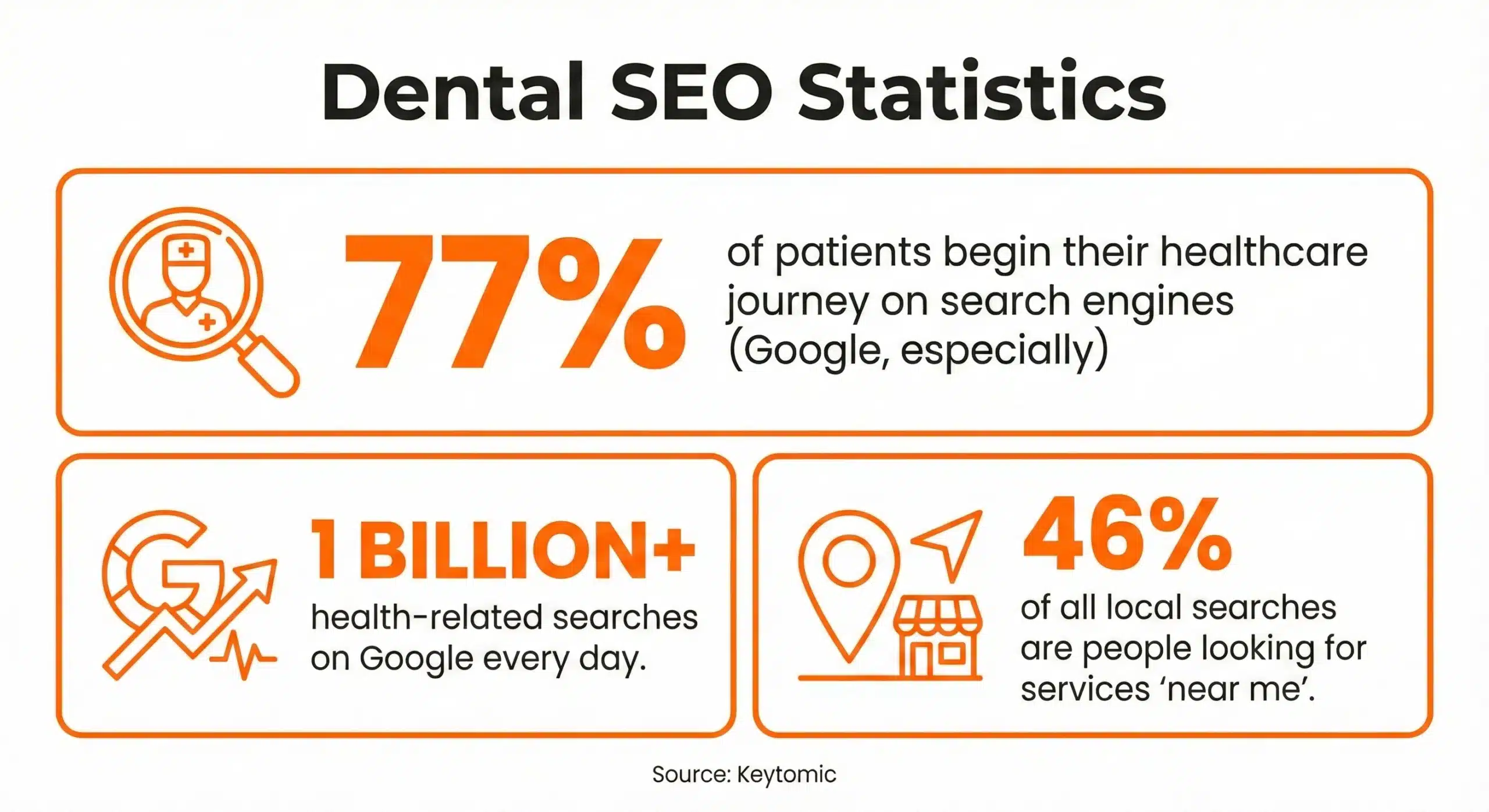
77% of patients use search engines before booking a dental appointment, making online visibility critical.
Local SEO is especially powerful for dentists since 72% of local searches result in store visits within 5 miles.
Dental practices investing in SEO see an average of 3-5x ROI within the first year.
The dentistry industry has high online competition, but strategic SEO gives smaller practices an advantage over corporate chains.
What is SEO for Dentists?
SEO (Search Engine Optimization) for dentists means making your dental practice website more visible when people search for dental services online.
When someone types “family dentist near me,” “emergency tooth pain help,” or “teeth whitening in Portland” into Google, proper SEO helps your practice appear in those search results.
The goal is simple: show up where your future patients are looking. Unlike traditional advertising where you interrupt people who might not need your services, SEO connects you with people actively searching for a dentist right now.
Think about your own behavior.
When you need a service, you probably pull out your phone and search Google. Your patients do the same thing. If your practice doesn’t appear in those search results, you’re invisible to them. It doesn’t matter how skilled you are or how modern your equipment is. You might as well not exist.
How SEO Works for Dental Practices
Google wants to show the best, most relevant results for every search. When someone searches for dental services, Google evaluates hundreds of factors to decide which practices deserve to rank on page 1. These factors include your website content, online reviews, local citations, mobile-friendliness, page speed, and dozens of other signals.
Your job with SEO is to optimize these factors so Google recognizes your practice as trustworthy, relevant, and helpful. Do this well, and you’ll rank higher. Rank higher, and more potential patients will find you. More visitors means more appointment bookings, which directly impacts your practice revenue.
The difference between ranking #1 and #10 on Google is dramatic. The top result gets roughly 28% of all clicks. By position #10, you’re getting less than 2%. Fall to page 2, and you might as well be invisible. Only 0.63% of searchers click anything on page 2.
Insight: Dental searches often have immediate intent. Someone searching “emergency dentist open now” or “toothache help” needs service today, not next week. Appearing in these searches captures patients at their moment of highest need.
Why SEO Matters for Dental Practices in 2026
The dental industry has changed dramatically in the past decade. Word-of-mouth referrals still matter, but they’re no longer enough to grow a thriving practice. Patients have fundamentally changed how they find and choose dentists.
Patients Start Their Search Online
Up to 77% of patients now use search engines before booking a dental appointment. They’re researching symptoms, comparing practices, reading reviews, checking credentials, and evaluating their options before they ever pick up the phone.
This shift means dental practices without a strong online presence are losing patients to competitors who invested in SEO.
Even if you’re the best dentist in town with decades of experience, patients won’t choose you if they can’t find you online.
Local Competition is Intense
Most areas have multiple dental practices competing for the same local patients. Corporate dental chains with large marketing budgets are expanding into new markets.
DSOs (Dental Support Organizations) are consolidating practices and investing heavily in digital marketing.
As a private practice or small group, you can’t outspend them on traditional advertising. But you can outwork them on local SEO.
Google doesn’t automatically favor big corporations with big budgets. It favors businesses that provide the best experience for local searchers. That levels the playing field.
Patient Acquisition Costs Keep Rising
Google Ads for dentists now cost $10-50+ per click in competitive markets. Facebook ads, direct mail, and billboard advertising all require continuous spending.
The moment you stop paying, the traffic stops. Your return on investment depends on constant ad spend.
SEO is different. It’s an investment that compounds over time. Every piece of content you create, every review you earn, every local citation you build continues working for you indefinitely.
After the initial investment, your cost per new patient from SEO drops dramatically while paid advertising stays expensive forever.
Marketing Channel | Typical Cost Per New Patient | Longevity | ROI Timeline |
|---|---|---|---|
SEO (Organic) | $200-400 initially, drops to $50-100 over time | Permanent, compounds over time | 6-12 months to positive ROI |
Google Ads | $150-400+ per patient (ongoing) | Stops when you stop paying | Immediate but constant cost |
Facebook Ads | $100-300 per patient (ongoing) | Stops when you stop paying | 1-3 months but constant cost |
Direct Mail | $300-600 per patient | Single campaign, no longevity | 3-6 months |
Emergency and After-Hours Searches Present Huge Opportunities
Dental emergencies don’t wait for business hours. Someone with severe tooth pain at 9 PM on a Saturday will search “emergency dentist near me open now” or “24-hour dental care.”
If your practice offers emergency services and ranks for these searches, you capture patients when they’re most desperate for help.
Even if you don’t offer 24/7 service, ranking for “same-day dental appointment” or “walk-in dentist” searches brings high-value patients who need immediate care and are less price-sensitive.
Understanding Google’s Ranking Factors for Dental Practices
Google uses over 200 ranking factors to decide which dental practices appear in search results.
You don’t need to optimize for all 200, but understanding the major factors helps you prioritize your efforts.
The Three Pillars of Dental SEO Success
Local Relevance
For dental practices, local SEO is everything. Google wants to show dentists near the person searching.
This means your Google Business Profile, local citations, NAP consistency (Name, Address, Phone), and location-specific content all heavily influence rankings.
Someone in Portland searching “family dentist” should see Portland dentists, not practices in Seattle.
Google determines your local relevance through signals like your address, service area, local content, and citations on local directories.
Trustworthiness & Authority
Google evaluates whether you’re a legitimate, trustworthy dental practice.
Factors include how long you’ve been in business, the quality and quantity of your online reviews, backlinks from reputable health websites, professional credentials, and consistency of information across the web.
A practice with 200 five-star Google reviews, mentions on Healthgrades and the ADA website, and a professionally maintained website signals high trustworthiness.
A practice with 3 reviews, no online presence, and inconsistent contact information looks questionable.
User Experience & Content Quality
Your website needs to work well for both search engines and actual humans.
This includes fast page loading (under 3 seconds), mobile-friendly design, helpful content that answers patient questions, clear navigation, and easy ways to book appointments.
Industry Insight
Google tracks how people interact with your site. If visitors immediately bounce back to search results, that signals your site doesn’t satisfy their needs. If they stay, browse multiple pages, and book appointments, Google knows you’re providing value.
E-E-A-T for Healthcare Websites
Google holds medical and dental websites to higher standards than most industries. This framework is called E-E-A-T (Experience, Expertise, Authoritativeness, Trustworthiness).
Experience: Show that real dentists with real experience run your practice. Include photos of your team, credentials, years in practice, specialized training, and case examples (respecting patient privacy).
Expertise: Demonstrate dental knowledge through high-quality content. Write blog posts about common dental issues, explain procedures in detail, answer frequently asked questions, and use proper dental terminology.
Authoritativeness: Build authority through reviews, professional affiliations (ADA membership), community involvement, and backlinks from other dental and health websites.
Trustworthiness: Maintain consistent information everywhere, secure your website with HTTPS, display transparent pricing when possible, and respond professionally to all reviews, especially negative ones.
Keyword Research for Dentists: Finding What Patients Actually Search
Most dentists assume they know what patients search for. Then they optimize for “dental services” or “teeth cleaning” and wonder why they don’t rank. The reality is patients use very different language than dental professionals.
The Types of Keywords That Drive Appointments
Location-Based Service Keywords
These are your bread and butter.
Patients want dentists near them, so they search “dentist in [city],” “[neighborhood] dental office,” or “family dentist near me.”
These keywords convert extremely well because the intent is clear: find a local dentist.
Create dedicated pages for each location you serve, each service you offer, and combinations of both.
“Pediatric Dentist in Downtown Seattle” targets both the service (pediatric) and location (downtown Seattle).
Problem/Symptom Keywords
When people have dental pain or concerns, they describe symptoms, not diagnoses.
They search “severe tooth pain,” “bleeding gums won’t stop,” “knocked out tooth what do I do,” or “bad breath no matter what I do.”
These searches represent people actively experiencing problems who need help immediately.
Creating content that addresses these symptoms positions you as the solution when they’re most motivated to book an appointment.
Procedure Keywords
Patients researching specific procedures use terms like “dental implants,” “teeth whitening cost,” “root canal recovery time,” or “Invisalign vs braces.”
These searchers are further along in their decision-making process and often ready to schedule consultations.
Target both the procedure name and variations: “dental implants,” “tooth implants,” “implant dentures,” “permanent false teeth,” “tooth replacement options.”
Question-Based Keywords
People ask Google questions like they’d ask a friend: “do I need a root canal,” “how often should I see a dentist,” “is teeth whitening safe,” “can you fix a chipped tooth,” or “what happens if you never floss.”
These questions make excellent blog post titles and FAQ content. Google often features this content in “People Also Ask” boxes and featured snippets, giving you prominent visibility.
Free Tools to Find the Right Keywords
Google Autocomplete
Start typing “dentist…” into Google search and watch the suggestions appear.
These are real searches from real people in your area. “dentist near me,” “dentist open Saturday,” “dentist that accepts [insurance]” all come from actual search data.
Do this for different starting phrases: “teeth…,” “tooth…,” “dental…,” “gums…,” “how to…,” “best way to….” You’ll discover dozens of keyword ideas patients actually use.
Google’s “People Also Ask”
When you search any dental term, Google shows a “People Also Ask” section with related questions. Click into each question to see even more questions. Within 5 minutes, you can generate 30-50 real question-based keywords.
Google Trends
See which dental terms are trending up or down over time. “Invisalign” searches have grown steadily. “Traditional braces” searches declined. This data helps you invest content creation in growing interest areas.
You can also compare regional interest. Maybe “cosmetic dentistry” searches are higher in urban areas while “family dentist” dominates suburban searches. Tailor your keyword strategy to your market.
Long-Tail Keywords Are Your Competitive Advantage
Short keywords like “dentist” get millions of searches but are nearly impossible to rank for as a local practice.
They’re also too broad. Someone searching “dentist” could be a dental student, someone looking for a TV show recommendation, or a tourist researching local services.
Long-tail keywords like “pediatric dentist near Bellevue accepting new patients” have much lower search volume but convert incredibly well.
The specificity means higher relevance, less competition, and better-qualified traffic.
Build your keyword strategy around 30-50 long-tail keywords specific to your location, services, and specialty.
You’ll rank faster, get more qualified traffic, and book more appointments than chasing impossible short keywords.
Local Keywords Best Practices
Focus on local keywords combining services with your city/neighborhood (e.g., “emergency dentist in Brooklyn Heights”).
Target symptom-based keywords that capture patients experiencing dental problems right now.
Question keywords make excellent blog content and appear in featured snippets.
Long-tail keywords (4+ words) convert better and have less competition than short generic terms.
Creating Content That Attracts and Converts Dental Patients
Content is where most dental practices fail at SEO. They create a basic “Services” page listing cleanings, fillings, and crowns, then wonder why they don’t rank. Google rewards comprehensive, helpful content that actually answers patient questions.
Essential Content Types for Dental Websites
Service Pages That Actually Explain Procedures
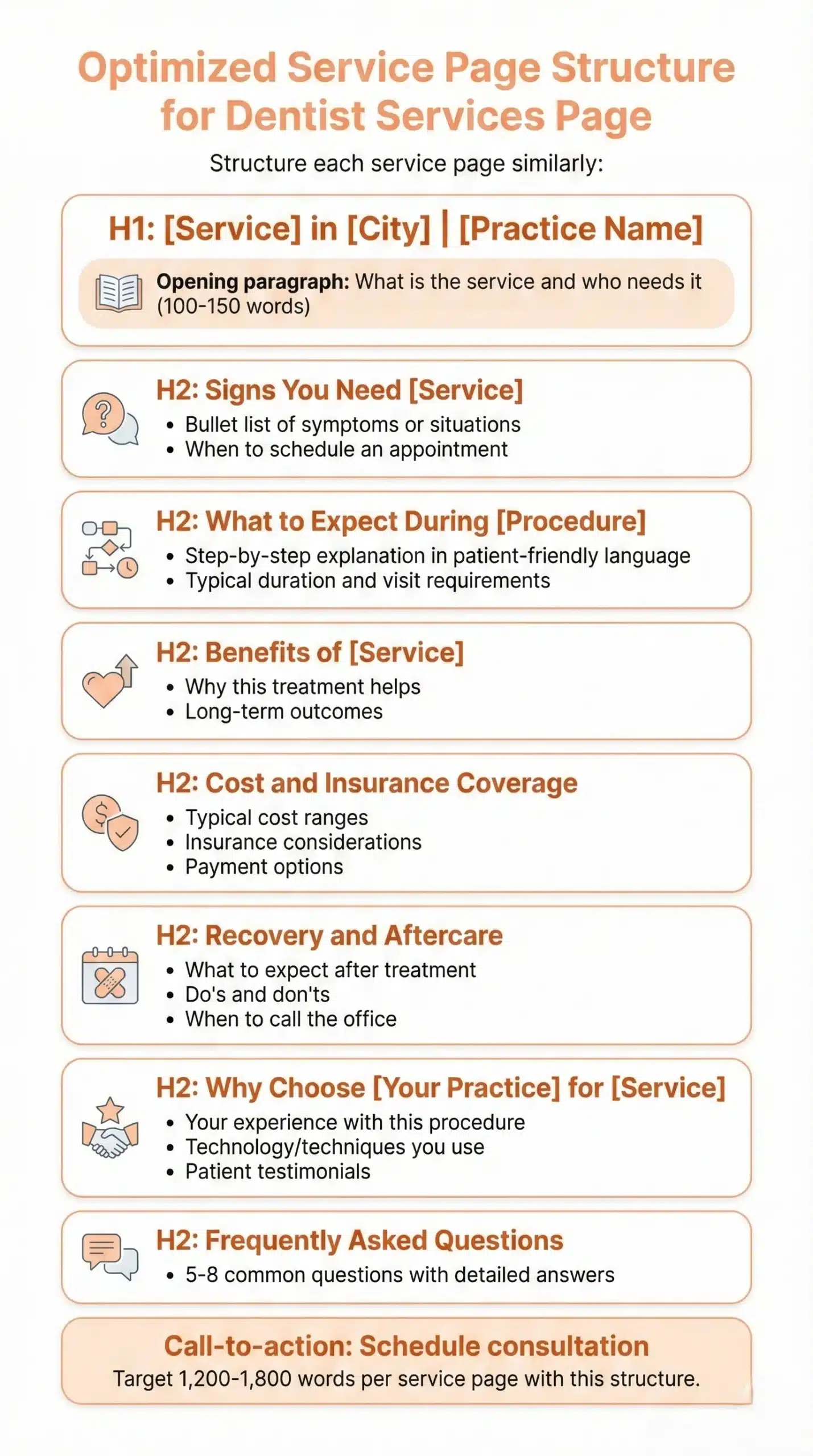
Don’t just list services. Create detailed pages explaining each procedure: what it is, when patients need it, what to expect during the appointment, recovery time, costs, insurance coverage, and before/after considerations.
For example, a root canal page should cover signs you need a root canal, the step-by-step procedure, pain management, how long it takes, aftercare instructions, costs, and why saving the tooth matters.
This comprehensiveness helps both SEO and patient education.
Structure each service page similarly to how it looks:
Educational Blog Posts That Build Trust
Blog posts position you as an expert while targeting informational keywords. Write about common dental concerns, prevention tips, treatment options, oral health for different age groups, and dental technology.
Great blog topics for dentists:
“7 Signs You Shouldn’t Ignore That Tooth Pain”
“How to Know If Your Child Needs Braces”
“The Real Cost of Dental Implants in [City]: Complete Breakdown”
“What to Do If You Knock Out a Tooth (Every Minute Counts)”
“Electric vs Manual Toothbrushes: What Dentists Actually Recommend”
“How Diet Affects Your Oral Health (It’s Not Just Sugar)”
Publish 2-4 blog posts monthly. Consistency matters more than volume. Regular publishing signals to Google that your site is active and authoritative.
Location Pages for Multi-Office Practices
If you have multiple locations, create unique pages for each office. Don’t just duplicate content and change the city name. Google penalizes duplicate content.
Make each location page unique with office-specific information, photos of that location, staff bios for that office, directions and parking details, hours specific to that location, and patient reviews mentioning that office.
Before and After Galleries (With Proper Consent)
Visual content showcasing your work builds trust and helps with image search SEO. Create galleries for different procedures: teeth whitening, veneers, smile makeovers, orthodontics, implants.
Always get proper written consent before using patient photos. Optimize images with descriptive file names (before-after-veneers-patient-1.jpg) and alt text describing what the image shows.
FAQ Pages That Answer Every Question
Compile the questions patients ask most frequently during consultations and create comprehensive FAQ pages. Group questions by category: general dentistry, cosmetic procedures, children’s dentistry, payment and insurance, emergency care.
Each answer should be 2-4 sentences minimum. Brief answers don’t rank well. Provide actual helpful information, not just “Contact us to learn more.”
Writing for Patients, Not Dental Professionals
The biggest content mistake dentists make is using too much professional jargon. You understand terms like “occlusal surface,” “interproximal cavity,” and “prophylaxis,” but your patients don’t. They search for “top of tooth,” “cavity between teeth,” and “teeth cleaning.”
Write at an 8th-grade reading level. Use simple language. Explain technical terms when you must use them. Your content should educate, not confuse.
Bad example: “Endodontic therapy addresses pulp necrosis through biomechanical instrumentation and obturation.”
Good example: “A root canal removes infected tissue from inside your tooth, cleans the area thoroughly, and seals it to prevent future infection. Most patients experience immediate relief from pain.”
Content Length Matters (But Quality Matters More)
Google tends to rank longer, more comprehensive content higher. For competitive dental keywords, top-ranking pages average 1,800-2,500 words. Service pages should be 1,200-1,800 words. Blog posts should be 1,500-2,500 words. Location pages can be shorter at 800-1,200 words if information is genuinely unique.
But don’t pad content just to hit word counts. Every paragraph should add value. If you’ve thoroughly covered a topic in 1,000 words, don’t add 500 words of fluff just to reach 1,500. Quality always beats quantity.
Local SEO for Dentists: Dominating Your Geographic Area
Local SEO deserves special attention for dentists because nearly all your patients come from your immediate area. National SEO rankings don’t matter if you can’t serve someone across the country. You need to rank for local searches in your specific city and neighborhoods.
Google Business Profile: Your Most Important Local SEO Asset
Your Google Business Profile (formerly Google My Business) appears in local search results and Google Maps. It’s often the first thing potential patients see when searching for dentists near them. Optimizing this free listing is the fastest way to improve local visibility.
Claim and Verify Your Listing
Search for your practice on Google Maps. If a listing exists, claim it. If not, create one at business.google.com. Google will verify your business through a postcard with a verification code sent to your practice address. This usually takes 5-7 business days.
Never try to game the system with fake addresses or multiple listings for one location. Google actively fights spam and will suspend profiles that violate guidelines.
Complete Every Single Field
Google rewards complete profiles with better rankings.
Fill out your business name (use your actual legal name, don’t stuff keywords), select accurate categories (primary: Dentist, secondary: Cosmetic Dentist, Pediatric Dentist, Emergency Dental Service, etc.), write a detailed 750-character business description, add all services you offer, list accurate hours including holiday hours, upload high-quality photos of your office, staff, and equipment, add your website URL and booking link, and enable messaging so patients can contact you directly.
Photos Drive Significant Engagement
Businesses with photos get 42% more requests for directions and 35% more clicks to their website compared to those without photos.
Upload at least 10-15 high-quality photos showing your office exterior and interior, treatment rooms, waiting area, front desk, your team, equipment, and happy patients (with consent).
Add new photos monthly to signal an active, well-maintained practice. Google favors businesses that regularly update their profiles.
Google Posts Keep You Visible
Google Posts appear in your Business Profile like social media updates. Use them to share practice news, special offers, new services, seasonal tips, holiday hours, staff introductions, and patient success stories.
Posts expire after 7 days, so create them weekly. They’re quick to make and keep your profile looking active and engaged.
Start Your Keytomic Trial Today!
Don’t rely on guesswork and outdated SEO strategies. Let Keytomic automate your SEO workflows so you can focus on what matters most; your brand.
Generate Your 30-Day CalendarBook Your Demo
Cancel Anytime. 14-Day Money Back Guarantee.
Reviews: The Most Influential Local Ranking Factor
Online reviews consistently rank as one of the top 3 local SEO factors. They influence both rankings and conversion rates.
A practice with 100+ positive reviews will outrank one with 5 reviews, even if the second practice has better traditional SEO.
The Numbers That Matter
Google prioritizes practices with more total reviews, higher average ratings (4.5-5 stars ideal), recent reviews (steady flow, not all from 2 years ago), and detailed reviews that mention specific services or staff members.
Aim to generate 5-10 new reviews monthly. This consistent flow signals to Google that your practice is active and patients are happy. A sudden spike of 50 reviews in one week looks suspicious and can trigger spam filters.
How to Get More Reviews Ethically
You can ask satisfied patients for reviews. What you cannot do is offer incentives, pay for reviews, or write fake reviews. Both violate Google’s policies and can get your entire profile suspended.
Create a simple review generation process. After successfully completing treatment, send a thank-you email or text that includes your Google review link.
Keep the ask simple: “We’d appreciate if you’d share your experience with a Google review to help other patients find us.”
Make it easy. Don’t make patients search for your listing. Provide the direct review link in emails, texts, and on your website.
Timing matters. Ask within 24-48 hours after treatment when the experience is fresh and satisfaction is highest. Waiting weeks or months reduces response rates dramatically.
Responding to All Reviews
Respond to every review, positive and negative. Thank people for positive reviews (keep it brief and genuine, don’t copy/paste the same response to everyone). For negative reviews, respond professionally, acknowledge their concern, take it offline, and offer to discuss directly.
Example negative review response: “Thank you for sharing your feedback. We’re sorry your experience didn’t meet expectations.
We’d appreciate the opportunity to discuss this further and make things right. Please contact our office manager directly at [phone] or [email]. We take all patient feedback seriously.”
Never argue, get defensive, or reveal protected health information in public responses. Stay professional no matter how unfair the review might be.
NAP Consistency Across the Web
NAP stands for Name, Address, Phone number. These three pieces of information must be exactly identical everywhere they appear online. Even minor differences confuse Google and hurt local rankings.
Check NAP consistency across your website (footer, contact page, about page, location pages), Google Business Profile, Facebook business page, Yelp, Healthgrades, Zocdoc, industry directories (Dental.com, 1-800-Dentist), local directories (Yellow Pages, local chamber of commerce), and review sites.
Common consistency problems: using “Street” vs “St,” “Suite 200” vs “Ste 200,” different phone numbers on different platforms, abbreviating city names on some sites, including or omitting suite numbers inconsistently.
Pick one exact format and use it everywhere. If your address is “123 Main Street, Suite 200,” never write it as “123 Main St, Ste 200” or “123 Main Street #200.” Perfect consistency matters.
Local Citations Build Authority
Citations are mentions of your practice’s NAP information on other websites. They validate to Google that your business is legitimate and established. More citations from quality sources improve local rankings.
Citation Type | Examples | Priority | Notes |
|---|---|---|---|
Major Data Aggregators | Neustar, Acxiom, Infogroup, Factual | Critical | These feed data to hundreds of smaller directories |
General Directories | Google Business Profile, Bing Places, Apple Maps, Yelp | Critical | Free, high-authority, must-have listings |
Dental-Specific Directories | Healthgrades, Zocdoc, 1-800-Dentist, Dental.com | High | Industry-relevant, attract patients actively seeking dentists |
Local Directories | Chamber of Commerce, local business associations | Medium | Build local relevance and community ties |
Social Platforms | Facebook, Instagram, LinkedIn | Medium | Not traditional citations but provide NAP validation |
Focus on quality over quantity. Ten citations on high-authority sites beat 100 citations on spammy low-quality directories. Some citation services spam your listing across hundreds of irrelevant directories, which can actually hurt more than help.
Technical SEO Basics Every Dental Practice Needs
Technical SEO ensures search engines can find, crawl, and index your website properly. Even with great content and lots of reviews, technical problems can completely prevent you from ranking. The good news is most dental websites have similar fixable technical issues.
Website Speed Affects Both Rankings and Appointments
Page speed is a confirmed Google ranking factor, but more importantly, it affects patient behavior. 53% of mobile users abandon sites that take longer than 3 seconds to load. If your appointment booking page loads slowly, patients leave and book with faster competitors.
Test your site speed using Google’s PageSpeed Insights (free). It analyzes your site and provides specific recommendations. Aim for scores of 80+ on both mobile and desktop.
Common speed killers for dental websites: uncompressed large images (before/after photos, team photos, office photos), too many plugins or scripts, slow web hosting, not using browser caching, render-blocking JavaScript and CSS.
Quick fixes that work: compress all images before uploading (use TinyPNG or similar tools, aim for images under 200KB), enable browser caching through your hosting provider or WordPress plugin, use a CDN (Content Delivery Network) to serve images faster, remove unnecessary plugins or scripts, and upgrade to better hosting if current hosting is slow (quality managed WordPress hosting costs $25-50/month and delivers significantly better performance).
Mobile-Friendly Design is Non-Negotiable
Over 60% of dental searches happen on mobile devices. Google uses mobile-first indexing, meaning it primarily uses the mobile version of your site for ranking.
If your site doesn’t work well on phones, you won’t rank well anywhere.
Test mobile-friendliness with Google’s Mobile-Friendly Test (free). It shows exactly how Google sees your mobile site.
Mobile UX problems to fix: text too small to read without zooming (use minimum 16px font size), buttons too close together or too small to tap (minimum 48px tall with spacing), content wider than the screen requiring horizontal scrolling, pop-ups covering content (especially on page load), forms difficult to fill out on mobile, and phone numbers that aren’t clickable tap-to-call links.
Your appointment booking process needs to be effortless on mobile. If patients struggle to book on their phones, they’ll call a competitor whose site works better.
Secure Website with HTTPS/SSL
Google requires HTTPS (the padlock in the browser address bar) for all websites. Sites without HTTPS show a “Not Secure” warning that scares visitors away. HTTPS is also a ranking factor.
Most hosting providers now include free SSL certificates. Installation is usually one-click from your hosting control panel. After installing, make sure all content loads over HTTPS. Mixed content warnings (some content on HTTPS, some on HTTP) break the secure connection.
For dental practices handling any patient information online (appointment requests, contact forms), HTTPS is legally required under HIPAA. You’re protecting patient data, not just improving SEO.
Schema Markup Helps You Stand Out
Schema markup is structured data code that helps search engines understand your content better and can make your listings stand out in search results with rich snippets showing star ratings, business hours, or FAQ answers directly in results.
The most valuable schema types for dentists:
LocalBusiness Schema: Identifies your practice type, location, hours, and contact info.
Dentist Schema: Specific schema for dental practices including specialties, credentials, and services.
MedicalBusiness Schema: Healthcare-specific structured data showing accepted insurance, conditions treated, and medical specialties.
Review Schema: Displays star ratings in search results when you have reviews.
FAQPage Schema: Makes your FAQ content eligible for rich results and featured snippets.
Implement schema using WordPress plugins like Rank Math or Schema Pro, or hire a developer to add it manually. Test your schema with Google’s Rich Results Test to ensure it’s correct.
Link Building for Dental Practices
Backlinks (other websites linking to yours) remain one of Google’s strongest ranking factors. When reputable health websites, local news sites, or professional organizations link to your practice, it signals authority and trustworthiness. But building quality backlinks takes strategy.
The Types of Backlinks That Help Dentists
Local News and PR Coverage
Getting featured in local news outlets, community websites, or local magazines provides valuable backlinks and exposure.
Offer expert dental commentary on relevant health news, sponsor local events or charities and get mentioned on their websites, participate in community health fairs, or create newsworthy content like original surveys or interesting data about local oral health.
A link from your city’s local news website is worth more for local SEO than a generic dental directory listing.
Professional Associations and Memberships
Join your state dental association, local dental society, and American Dental Association. Most include member directories with backlinks.
These links are highly authoritative because they come from established professional organizations.
Other valuable associations: Academy of General Dentistry, American Academy of Cosmetic Dentistry, American Academy of Pediatric Dentistry (if applicable), local chamber of commerce, Better Business Bureau with BBB accreditation.
Educational Content and Resources
Create genuinely useful resources that other websites want to link to. Examples include comprehensive guides (oral health during pregnancy, dental care for seniors, choosing the right toothbrush), original research or surveys (local oral health statistics, patient behavior studies), free tools (cost calculator for different procedures, treatment timeline guides), and infographics about dental topics.
Industry Insight
When you create something truly valuable, reach out to relevant websites (parenting blogs, senior care sites, local health organizations) and let them know about your resource. Many will link to it as a helpful reference for their audience.
Guest Posts on Health and Wellness Sites
Writing guest posts for established health blogs, parenting websites, or local publications provides backlinks and demonstrates expertise.
Pitch topics relevant to their audience but within your expertise: “5 Foods That Strengthen Teeth” for health blogs, “When Should Kids First Visit the Dentist” for parenting sites, “Oral Health Warning Signs Seniors Shouldn’t Ignore” for senior care resources.
Keep the content educational, not promotional. These sites want to help their readers, not publish advertising for your practice.
Link Building Strategies to Avoid
Don’t Buy Links
Paying for backlinks violates Google’s guidelines. If caught, you risk a manual penalty that can devastate your rankings. Recovery from penalties can take 6-12 months or longer.
Avoid Link Farms and PBNs
Private Blog Networks (PBNs) are networks of websites created solely to sell links. Google has gotten very good at identifying and devaluing these. They won’t help and may hurt.
Skip Low-Quality Directory Spam
Submitting your practice to 500 random directories wastes time and provides no value. Focus on quality dental-specific directories (Healthgrades, Zocdoc) and relevant local directories only.
Don’t Over-Optimize Anchor Text
If every backlink to your site uses the exact same keyword anchor text (“best dentist in Chicago”), it looks manipulative. Natural link profiles have varied anchor text including your practice name, generic phrases, and natural contextual variations.
Link Building Best Practices
Earn 3-5 high-quality backlinks per month through relationship building and creating valuable resources.
Prioritize local news coverage, professional associations, and industry directories over generic links.
Create linkable assets (guides, research, tools) that naturally attract backlinks over time.
Avoid paid links, link schemes, or anything that violates Google’s Search Console Guidelines.
Measuring Your Dental SEO Success
SEO without measurement is guesswork. You need to track specific metrics to understand what’s working, identify problems early, and prove ROI. The right metrics tell you if your investment is paying off or if you need to adjust strategy.
The Metrics That Actually Matter
Organic Traffic Growth
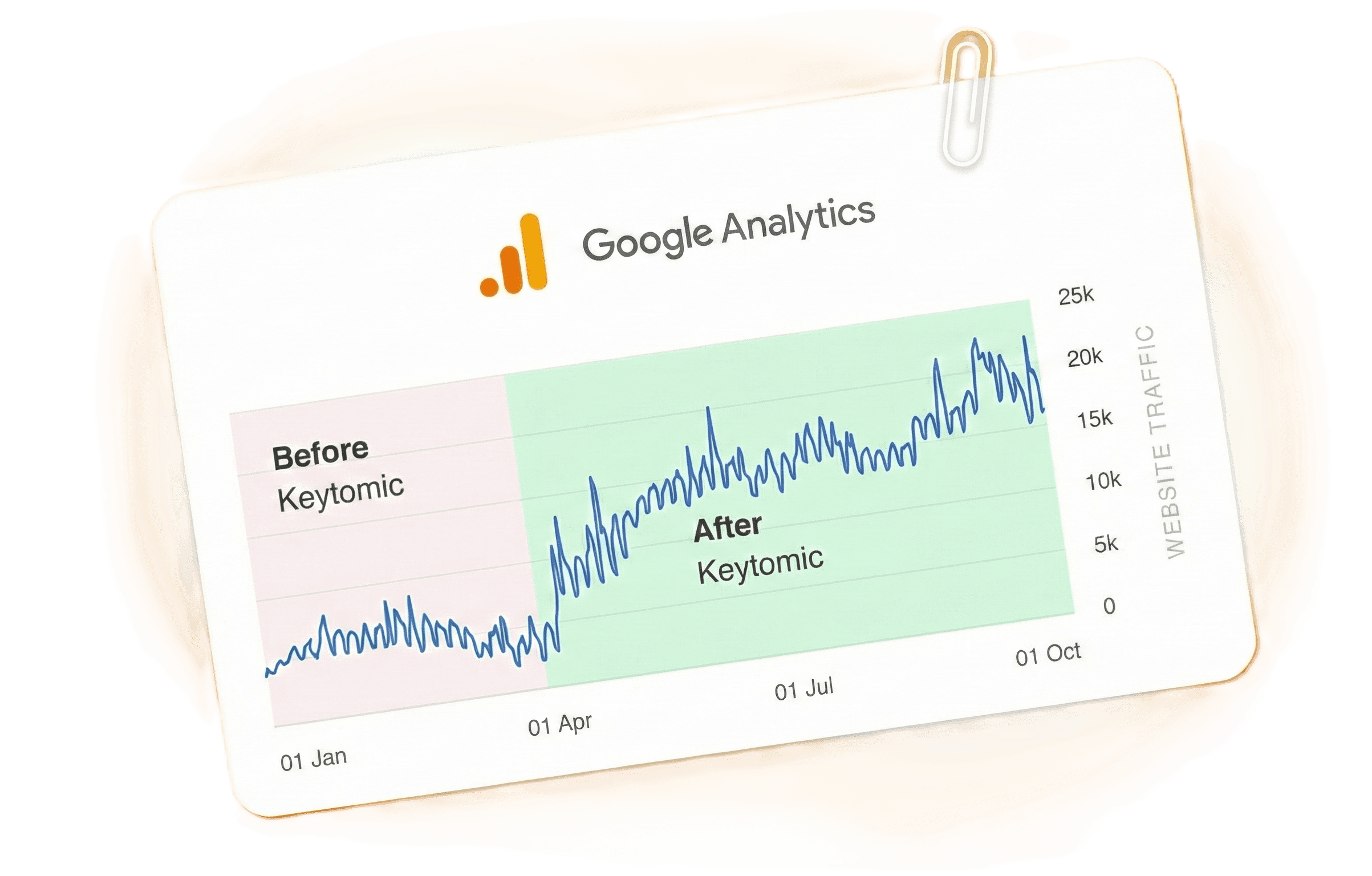
The most fundamental metric is how many people visit your site from organic (unpaid) search. Track this month-over-month in Google Analytics. Healthy dental SEO should show steady traffic growth of 10-20% month-over-month in the first year.
Google Business Profile Actions
Track how many people request directions, call your practice, visit your website, or message you through your Google Business Profile. These actions represent real patient interest, not just passive views.
Phone Calls from Organic Search
Use call tracking software to identify which phone calls come from organic search vs paid ads or other sources. This directly ties SEO to appointment bookings.
Appointment Requests from Website Forms
Set up conversion tracking in Google Analytics to monitor contact form submissions, appointment booking requests, and emergency contact form completions. Track these by traffic source to see how many come from organic search.
Keyword Rankings for Target Terms
Track where you rank for your most important keywords: “dentist in [city],” “emergency dentist [location],” “[specific service] [city],” and other high-priority terms. Rankings alone don’t matter (traffic and appointments do), but they’re a useful leading indicator of progress.
Return on Investment (ROI)
Calculate how much revenue SEO generates compared to what you invest. Track new patients from organic search, calculate average patient lifetime value, and compare it to your monthly SEO investment.
Industry Insight
Example ROI calculation: If you invest $3,000/month in SEO and it brings 15 new patients per month with an average lifetime value of $2,000 each, that’s $30,000 in patient value monthly. ROI = ($30,000 – $3,000) / $3,000 = 900% ROI.
Setting Up Google Analytics 4 for Dental Practices
Google Analytics shows who visits your website, where they come from, what they do, and whether they convert into appointments. It’s free and essential.
Create a Google Analytics 4 account and add the tracking code to your website. Most WordPress themes have a field to paste your tracking ID, or use a plugin like MonsterInsights.
Set up key events (conversions): appointment form submission, phone number clicks, email clicks, live chat initiations, directions requests, and downloadable content (patient forms, post-care instructions).
Create custom reports showing organic traffic by service page, conversion rates by landing page, user demographics and geographic data, and most popular content.
Using Google Search Console
Google Search Console (free) shows exactly how your site performs in Google search. It provides data Google Analytics can’t, like which keywords trigger impressions of your site, your average ranking positions, your click-through rates, and technical issues affecting indexing.
Key reports to monitor:
Performance Report:
Shows impressions, clicks, average position, and click-through rate for every keyword. Look for keywords ranking on page 2 (positions 11-20) with decent impressions. These are prime candidates to target with better content to push to page 1.
Index Coverage:
Shows which pages Google has indexed and any indexing problems. Fix errors that prevent important pages from appearing in search.
Core Web Vitals:
Tracks page experience metrics Google uses for rankings (loading speed, interactivity, visual stability). Fix any failing pages.
Start Your Keytomic Trial Today!
Don’t rely on guesswork and outdated SEO strategies. Let Keytomic automate your SEO workflows so you can focus on what matters most; your brand.
Generate Your 30-Day CalendarBook Your Demo
Cancel Anytime. 14-Day Money Back Guarantee.
Setting Realistic Timeline Expectations
SEO takes time. Don’t expect overnight results. Here’s a realistic timeline for dental practices:
Months 1-3
Foundation building. You’ll see minimal results but you’re laying groundwork with content, citations, and optimization. Some quick wins possible for easy long-tail keywords.
Months 3-6
Early traction. Rankings improve for less competitive keywords, organic traffic starts growing, Google Business Profile actions increase, and first new patients from SEO arrive.
Months 6-12
Momentum building. Traffic growing steadily month-over-month, ranking for more competitive service keywords, consistent patient inquiries from organic search, and ROI approaching or turning positive.
Months 12-18
Compounding returns. Strong traffic growth, ranking for highly competitive local terms, steady predictable patient acquisition from SEO, and strong positive ROI (typically 5-10x).
18+ months
Mature strategy. Dominant local rankings, high-volume consistent traffic, SEO as primary patient acquisition channel, and dramatic ROI (10-15x+ possible).
Common SEO Mistakes Dental Practices Make
Even practices investing in SEO often make critical mistakes that limit results. Avoid these common pitfalls.
Using Stock Photos Instead of Real Practice Images
Google rewards authentic, original content. Using generic stock photos of perfect models pretending to be dentists looks fake and doesn’t build trust.
Patients want to see your actual office, your real team, and your authentic environment.
Invest in professional photography of your practice, team, equipment, and patient interactions (with consent). Original photos improve both SEO and conversion rates.
Ignoring Patient Questions and Concerns
Many dental websites focus on services without addressing the questions patients actually have: Does it hurt? How much does it cost? How long does it take? What if I have dental anxiety? Do you take my insurance?
Create content that directly answers these questions. FAQ pages, service page sections, and blog posts addressing concerns convert better than technical procedure descriptions.
Having Separate Desktop and Mobile Websites
Some older dental websites still use separate desktop (www.) and mobile (m.) versions. This creates duplicate content issues, splits your SEO authority, and creates technical headaches.
Use responsive design that automatically adapts to any screen size.
Neglecting Emergency Dental Keywords
Emergency dental searches represent high-intent patients who need immediate help and are less price-sensitive. Yet many practices don’t optimize for “emergency dentist,” “same-day dental appointment,” “tooth pain help now,” “broken tooth repair,” or “knocked out tooth what to do.”
If you offer emergency services, create dedicated emergency dental pages and make it very clear you’re available for urgent care.
Publishing Thin, Duplicate Content
Creating dozens of service pages with just 200 words of identical content except for the service name won’t rank.
Neither will copying content from other dental websites or using the same content manufacturer websites provide.
Google penalizes thin and duplicate content. Every page needs substantial unique content (800+ words minimum for service pages).
Not Claiming All Local Listings
Some practices claim Google Business Profile but ignore Bing Places, Apple Maps, Yelp, Healthgrades, and other directories.
Each listing provides citation value, potential backlinks, and another place patients can find you.
Claim and optimize all relevant free listings. It takes a few hours but provides ongoing SEO benefit.
The Keytomic Advantage: Automate Your Dental Practice SEO
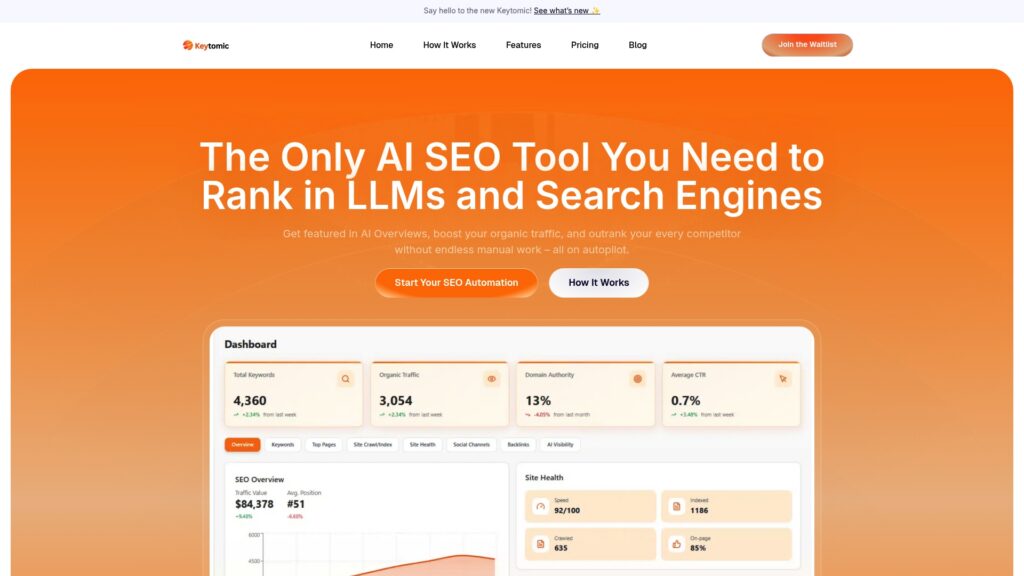
Most dental practices struggle with SEO for the same reason: it’s incredibly time-consuming.
Between seeing patients, managing staff, handling insurance, and running a business, you don’t have 15-20 hours per week for SEO tasks.
Traditional dental SEO requires constant manual work. You need keyword research to identify opportunities, content creation for blogs and service pages, technical optimization of every page, local citation building across dozens of directories, review monitoring and response management, rank tracking across hundreds of keywords, competitor monitoring to see what’s working for them, and regular content updates to stay current.
Even if you hire a traditional dental marketing agency, you’re paying $3,000-7,000+ per month for this manual work.
Results take 6-12 months to materialize, and you’re dependent on their capacity and prioritization.
How Keytomic Changes Dental SEO
Keytomic automates the heavy lifting while you maintain control over strategy. Here’s what’s different:
Automated Keyword Research
Instead of spending hours manually researching dental keywords in your area, Keytomic analyzes your location, services, and competitors to identify high-value keyword opportunities automatically. You get a prioritized list of exactly which keywords to target based on search volume, competition, and patient intent.
AI-Powered Content Generation
Generate complete, SEO-optimized content for service pages, blog posts, and location pages in minutes instead of hours. The content follows dental SEO best practices, includes proper keyword integration, maintains readability for patients (not dentists), and passes AI detection tools to rank well.
You maintain final editing control to add your practice’s unique voice, specific credentials, and local touches, but the heavy lifting of research and initial drafting is automated.
One-Click Publishing
Content goes live on your WordPress site automatically with proper formatting, appropriate header tags (H1, H2, H3 hierarchy), optimized images with alt text, internal linking to related pages, schema markup implementation, and complete meta titles and descriptions.
Multi-Platform Indexing
Your content gets indexed not just on Google, but across ChatGPT, Perplexity, Gemini, and other AI search platforms simultaneously. As more patients ask AI assistants questions like “find me a good dentist near me” or “which dentist in Portland does Invisalign,” your practice appears in those AI-generated answers.
Built-in GEO Optimization
Generative Engine Optimization (GEO) ensures your content is structured and formatted to be cited by AI tools when they answer dental questions. Traditional SEO alone won’t position you for this growing search behavior. Keytomic optimizes for both traditional Google search and AI-powered search automatically.
Automated Performance Tracking
Real-time dashboards show keyword rankings, organic traffic growth, Google Business Profile metrics, and content performance without manually checking 12 different tools and compiling spreadsheets.
Why Dental Practices Choose Keytomic
Save 70% of Time
What used to take 15-20 hours per week of manual SEO work now takes 3-5 hours with Keytomic handling content creation, optimization, and publishing. You focus on strategy and patient care while the platform executes tactics.
Scale Content Production
Publish 10-15 pieces of optimized content monthly without hiring writers, editors, and SEO specialists. Consistent content production is what separates practices that dominate local SEO from those that stay invisible.
Reduce Costs Significantly
Most practices using Keytomic spend 50-60% less on SEO than those using traditional agencies while producing 2-3x more content. You’re paying for smart automation, not manual labor hours.
Get Results Faster
Automated workflows mean faster implementation. What takes traditional agencies 2-3 months to complete happens in 2-3 weeks with Keytomic. Faster implementation means faster results.
Future-Proof Your SEO
With AI search optimization built in, your practice is ready for how patients will search in 2026 and beyond, not just how they searched in 2020. Stay ahead of competitors still focused only on traditional Google SEO.
Take the manual time investment out of SEO so you can focus on practicing dentistry. Learn more about Keytomic’s dental SEO automation.
Start Your Keytomic Trial Today!
Don’t rely on guesswork and outdated SEO strategies. Let Keytomic automate your SEO workflows so you can focus on what matters most; your brand.
Generate Your 30-Day CalendarBook Your Demo
Cancel Anytime. 14-Day Money Back Guarantee.
Frequently Asked Questions About SEO for Dentists
How long does it take to see results from dental SEO?
Most dental practices see initial results within 3-6 months, with significant traffic and patient growth appearing around the 9-12 month mark. Timeline depends on your starting point (new practice vs established), market competition (rural area vs major metro), and SEO investment level (DIY vs agency vs automation platform).
How much should a dental practice spend on SEO?
Most dental practices invest $2,000-6,000 per month on SEO depending on market size, competition level, and growth goals. Solo practitioners in smaller markets might see results with $1,500-2,500 monthly.
Can I do SEO myself or should I hire an agency?
You can handle basic dental SEO yourself if you have 10-15 hours per week available for learning and execution. Start with claiming your Google Business Profile, building citations, optimizing existing pages, and publishing monthly blog content. However, most dentists find it more profitable to outsource while they focus on seeing patients. Your time practicing dentistry is worth $300-500+ per hour. Spending 15 hours weekly on SEO means sacrificing $4,500-7,500 in potential practice revenue. Hiring an agency or using an automation platform like Keytomic typically costs less than the opportunity cost of DIY. Hybrid approaches work well: handle patient-facing activities like review requests while outsourcing technical SEO, content creation, and link building to specialists.
What’s the difference between dental SEO and Google Ads?
Dental SEO builds long-term organic visibility through unpaid search results and compounds over time, while Google Ads delivers immediate paid traffic that stops the moment you stop paying. SEO typically requires 6-12 months to show meaningful results but delivers 5-10x ROI long-term with decreasing cost-per-patient as rankings improve. Google Ads provides instant visibility and immediate patient calls but at ongoing cost-per-click rates of $10-50+ for dental keywords. Most successful practices use both: Google Ads for immediate patient flow while building SEO for long-term sustainable growth, then gradually shift budget from paid ads to SEO as organic traffic scales. SEO also benefits from implied endorsement (organic rankings feel more trustworthy than ads), while paid ads allow precise targeting and immediate testing.
Do dental directories like Healthgrades and Zocdoc help SEO?
Yes, profiles on Healthgrades, Zocdoc, Vitals, and similar dental directories help your SEO in multiple ways. First, they provide citation value (NAP mentions) that improve local rankings. Second, many are high-authority sites that provide backlinks to your website. Third, directory profiles often rank for your practice name and services, giving you more visibility in search results even if someone doesn’t click through to your site. Fourth, they provide social proof through patient reviews that influence booking decisions. However, your own optimized website should always be the priority. Directory profiles supplement your SEO but can’t replace strong presence on your own domain. Claim free listings on major directories but be selective about paid premium listings, evaluating ROI based on actual patient acquisitions.
How important is blogging for dental SEO?
Blogging is very important for dental SEO because it targets informational keywords that bring traffic from people researching dental issues before they’re ready to book appointments. Regular blog posts demonstrate expertise to Google, build topical authority in dentistry, provide content to share on social media, and create opportunities for internal linking to service pages. Most importantly, blog content ranks for long-tail question keywords with less competition than service pages. A well-optimized blog post targeting “how to stop bleeding gums” can rank within weeks and bring steady traffic for years. Aim for 2-4 quality blog posts per month minimum. Focus on answering real patient questions rather than writing about topics that interest you professionally. Consistency matters more than volume, consistent monthly publishing signals authority and freshness to Google.
What is local SEO and why does it matter for dentists?
Local SEO optimizes your online presence for location-based searches like “dentist near me,” “emergency dentist in Portland,” or “pediatric dentist downtown Seattle.” It’s critical for dental practices because 72% of local searches result in store visits within 5 miles, patients typically choose dentists within 5-10 minutes driving distance, and local search intent is extremely high (someone searching for a local dentist needs one now, not eventually). Local SEO focuses on Google Business Profile optimization, local citations and directory listings, NAP consistency across all platforms, location-specific content on your website, and managing online reviews. Unlike traditional SEO that might target national keywords, local SEO ensures you appear when people in your service area search for dental services. This is where most patient acquisition happens for dental practices, making local SEO often more valuable than traditional organic SEO.
Start Growing Your Dental Practice Through SEO

Your potential patients are searching for dental services right now. The practices that rank on page 1 of Google will get the appointments. The practices buried on page 3 won’t even be considered.
SEO provides a sustainable competitive advantage that compounds over time. Unlike paid advertising that stops working when you stop paying, SEO builds momentum. Every piece of content you create, every review you earn, and every citation you build continues working for you indefinitely.
The dental practices that start now and execute consistently for the next 12-18 months will dominate their local markets. The practices that wait will spend years trying to catch up.
Ready to stop losing patients to competitors who rank higher on Google? Keytomic automates your dental SEO workflow so you can get results without spending 15-20 hours per week managing keywords, content, and optimization. Focus on what you do best (dentistry) while Keytomic handles getting you found online.
Salam Qadir
Product & Growth Lead
Salam is an award-winning SEO & marketing strategist with over 5 years of experience helping SaaS companies dominate search rankings.
Limited Offer

Get Ranked, and Cited Where Matters!
Turn your website into organic growth and leads on auto-pilot!
Keyword research
CMS integrations
AI visibility tracking
SEO health audit