

Choosing between SEO tools can drain budget and slow down workflows. Content managers, SEO specialists, and agencies need clarity on which platform delivers results for their specific use case.
This comparison is for content managers, SEO specialists, and agency owners who are tired of the “it depends” answer.
In 2026, the SEO landscape has shifted. You aren’t just ranking for ten blue links anymore; you are optimizing for AI Overviews, Featured Snippets, and Generative Engine Optimization (GEO).
The question isn’t just “which tool has better data?” The question is “which tool actually fits my team’s workflow?”
Below, we break down every critical dimension (from data depth to hidden pricing limits) so you can stop guessing and start executing.
Key Takeaways
- Ahrefs dominates keyword research and backlink analysis with 24 trillion indexed links globally.
- Surfer SEO leads content optimization through real-time scoring and on-page term suggestions.
- Most agencies need both platforms because Ahrefs informs strategy while Surfer guides execution.
- Combined tool costs range $300-$800 monthly depending on team size and usage volume.
- Neither tool tracks AI search citations requiring specialized platforms for GEO visibility monitoring.
Quick Answer: Surfer SEO vs Ahrefs
Ahrefs excels at SEO strategy and competitive intelligence with comprehensive backlink analysis, SERP research depth, and keyword difficulty metrics.
Surfer SEO specializes in content optimization with real-time on-page scoring, term coverage suggestions, and writing workflow integration.
Most agencies and content teams need both tools because Ahrefs identifies what to create while Surfer guides how to optimize during writing.
Content writers benefit most from Surfer SEO because the platform provides actionable on-page guidance while drafting.
SEO strategists gain more value from Ahrefs because competitive landscape analysis and backlink intelligence inform content strategy.
Agencies typically invest in both tools to cover strategy development and execution workflows.
Teams prioritizing AI search visibility need entity coverage and structured content, which both tools support indirectly through topical completeness and heading optimization.
Quick Verdict by Use Case
Different roles require different capabilities. This section identifies which tool serves specific team functions most effectively.
If You Are a Writer or Content Lead
Surfer SEO provides superior value for content creation workflows. The platform scores drafts in real-time based on SERP analysis. Writers receive specific term suggestions, heading structure recommendations, and content length guidance while typing. The Content Editor interface integrates directly into content management systems through browser extensions.
Ahrefs lacks writing assistance features. The platform identifies topics worth creating but provides no draft-level optimization guidance. Writers using only Ahrefs must manually translate keyword research into content structure decisions without real-time feedback.
If You Are an SEO Strategist or Growth Lead
Ahrefs delivers comprehensive competitive intelligence that informs strategy decisions. The platform tracks 170 billion keywords across 170 countries. Keyword Difficulty scores incorporate backlink profiles of ranking pages. SERP analysis reveals content gaps competitors miss. Site Explorer exposes competitor traffic sources and top-performing content.
Surfer SEO offers limited strategic depth. Content planners see topical suggestions but lack backlink context for competitive niches. Strategic decisions about which keywords merit investment require link intelligence that Surfer does not provide.
If You Are an Agency
Agencies require both platforms for complete client service. Ahrefs handles competitive audits, keyword research, and backlink analysis during strategy development. Surfer SEO standardizes content quality across multiple writers producing client deliverables. The combined monthly cost typically ranges from $300 to $800 depending on plan tiers and usage volume.
Stack cost becomes problematic when clients require comprehensive reporting. Neither platform exports data in formats that match typical client reporting needs. Agencies manually compile data from both tools into presentation documents.
If You Care About AI SEO and GEO Outcomes
Neither Surfer SEO nor Ahrefs directly tracks AI search visibility. Both tools indirectly support Generative Engine Optimization through content completeness and entity coverage. Surfer ensures topical breadth by suggesting missing subtopics. Ahrefs identifies entities commonly discussed in ranking content through SERP analysis.
Direct AI citation tracking requires specialized platforms that monitor mentions across ChatGPT, Perplexity, and Google AI Overviews. Traditional SEO tools focus on traditional search engine rankings rather than large language model outputs.
The Core Difference: Data vs Action
Table: Surfer SEO vs Ahrefs Feature Comparison
| Feature/Capability | Surfer SEO | Ahrefs | Winner | Notes |
|---|---|---|---|---|
| Keyword Research Depth | Limited (Content Planner only) | Comprehensive (170B keywords) | Ahrefs | Ahrefs provides search volume, KD scores, SERP analysis |
| Keyword Database Size | Small (semantic suggestions) | 170 billion keywords | Ahrefs | Largest commercial keyword database globally |
| Backlink Analysis | Not available | 24 trillion indexed backlinks | Ahrefs | Industry-leading backlink database and tracking |
| Content Editor | ✓ Market-leading | Not available | Surfer | Real-time scoring with term/entity suggestions |
| On-Page Optimization | ✓ Comprehensive | Basic (SERP analysis only) | Surfer | Draft-level guidance during writing |
| Content Scoring | ✓ Real-time (0-100 scale) | Not available | Surfer | Competitive benchmarking against top 10-50 results |
| Entity Coverage Suggestions | ✓ Automated | Manual (from SERP analysis) | Surfer | Identifies brands, concepts, metrics to include |
| Technical SEO Audit | Basic (page-level only) | ✓ Comprehensive (130+ issues) | Ahrefs | Site-wide crawling up to 100,000 pages |
| Site Health Monitoring | Limited | ✓ Continuous crawling | Ahrefs | Identifies broken links, duplicates, speed issues |
| Competitor Analysis | Content structure only | ✓ Full domain intelligence | Ahrefs | Traffic sources, backlinks, top content revealed |
| Content Gap Analysis | Not available | ✓ Advanced | Ahrefs | Shows keywords competitors rank for that you don’t |
| SERP Position Tracking | Not available | ✓ Unlimited keywords | Ahrefs | Daily ranking updates on higher plans |
| Link Building Intelligence | Not available | ✓ Comprehensive | Ahrefs | Anchor text, link velocity, referring domains |
| Heading Structure Analysis | ✓ Automated suggestions | Manual review | Surfer | Suggests H2/H3 based on top-ranking content |
| Word Count Guidance | ✓ Target ranges provided | Manual calculation | Surfer | Shows optimal length based on SERP analysis |
| Content Briefs | ✓ Automated generation | Manual creation | Surfer | SERP Analyzer creates detailed briefs |
| Internal Linking Suggestions | Not available | Link analysis only | Tie | Neither provides automated suggestions |
| Schema Markup Detection | Not available | ✓ Technical audit | Ahrefs | Identifies missing or incorrect schema |
| Mobile Optimization Check | Not available | ✓ Site audit | Ahrefs | Mobile usability issue detection |
| Page Speed Analysis | Not available | ✓ Core Web Vitals | Ahrefs | Performance metrics and recommendations |
| Duplicate Content Detection | Not available | ✓ Site-wide | Ahrefs | Identifies canonical and duplicate issues |
| Topic Clustering | ✓ Content Planner | Keyword grouping | Surfer | Semantic topic suggestions for planning |
| Multi-Language Support | ✓ Available | ✓ 170 countries | Tie | Both support international SEO |
| Team Collaboration | ✓ Content sharing | ✓ User management | Tie | Both offer team features on higher plans |
| API Access | Limited | ✓ Comprehensive | Ahrefs | Full API for custom integrations |
| Chrome Extension | ✓ Content Editor | ✓ SEO toolbar | Tie | Both provide browser extensions |
| Reporting Dashboards | Basic | ✓ Comprehensive | Ahrefs | Custom reports and data exports |
| Historical Data | Limited | ✓ Years of history | Ahrefs | Ranking and backlink trends over time |
| AI Visibility Tracking | Not available | Not available | Neither | Both lack ChatGPT/Perplexity citation monitoring |
| GEO Optimization | Indirect support | Indirect support | Neither | Both help indirectly through completeness |
| Pricing (Starting) | $89/month (Essential) | $129/month (Lite) | Surfer | Lower entry price point |
| Usage Limits | Article caps (30-150) | Credit system (500+) | Varies | Both have usage restrictions by plan |
| Learning Curve | Easy (writing-focused) | Moderate (data-heavy) | Surfer | More intuitive for content teams |
| Best For | Writers, content teams | SEO strategists, agencies | Depends | Role-specific strengths |
| ROI Timeline | Immediate (per article) | 3-6 months (strategic) | Surfer | Faster visible content improvements |
Ahrefs functions as strategic intelligence. Surfer SEO operates as tactical execution support. Understanding this fundamental distinction clarifies when each tool provides value.
Define “Data” in SEO Tool Terms
Data-heavy platforms provide competitive intelligence and market analysis. Ahrefs delivers SERP position tracking, backlink growth trends, competitor domain authority comparisons, and historical ranking changes. These capabilities inform strategic decisions about content investment priorities.
Keyword research depth determines data value. Ahrefs indexes over 24 trillion backlinks and 170 billion keywords. This database size enables confidence in search volume accuracy and competitive landscape assessment.
Define “Action” in SEO Tool Terms
Action-oriented tools guide immediate optimization decisions. Surfer SEO analyzes top-ranking content and generates specific recommendations. Writers receive entity lists, heading suggestions, word count targets, and term density guidance. These recommendations translate directly into draft improvements.
Real-time scoring creates feedback loops. Content scores update as writers add sections. This immediate response allows optimization during creation rather than after publishing.
Visual: Venn Diagram Description
The left circle represents Ahrefs capabilities including backlink analysis, competitor domain tracking, link velocity monitoring, and SERP movement history. The right circle shows Surfer SEO functions covering on-page term analysis, heading optimization, content structure scoring, and draft-level suggestions.
The overlap includes keyword research decisions, topical planning for content calendars, and competitive content brief creation. Both platforms inform these workflows but emphasize different inputs.
Round 1: Keyword Research and Data Depth
Keyword selection determines content success. Research depth separates strategic planning from guesswork.
Ahrefs: The King of Data
Ahrefs maintains the largest commercial keyword database with 170 billion keywords across 170 countries. Keyword Difficulty scores range from 0-100 based on ranking page backlink profiles.
SERP analysis reveals domain ratings, backlink counts, and referring domains for top 100 results. This intelligence shows whether ranking requires extensive link building or primarily depends on content quality.
Keywords Explorer generates related suggestions through “Questions,” “Also rank for,” and “Having same terms” methods. These expansion capabilities help teams discover comprehensive topic coverage opportunities.
Surfer SEO: The Semantic Context
Surfer Content Planner suggests topics based on semantic relationships. Users input seed keywords and receive topic clusters with estimated traffic potential and content difficulty scores. This helps prioritize immediate creation versus future planning.
The platform limits strategic depth because backlink context remains invisible. Content planners cannot determine whether topics require link campaigns for ranking success in competitive niches.
Gap: Overkill vs Missing Inputs
Ahrefs provides excessive data for simple blogs targeting low-competition keywords. Surfer lacks critical inputs for competitive markets where domain authority matters. Legal, finance, and healthcare niches typically need significant authority that Surfer cannot assess.
Example: “AI SEO tools” shows 2,400 monthly searches with Keyword Difficulty 38 in Ahrefs. Ranking pages have 45-200 referring domains, indicating moderate competition requiring content plus link acquisition. Surfer suggests related topics but provides no backlink context. Writers might create content that cannot rank without link campaigns.
Verdict
Ahrefs wins keyword research for strategic planning. Surfer wins for converting approved keywords into optimized content.
If you’re an agency managing multiple clients interested in programmatic content scaling, explore Complete Guide to Programmatic SEO for Content Teams for high-volume optimization strategies.
Industry InsightAhrefs maintains the largest commercial keyword database with 170 billion keywords across 170 countries, updating search volume data monthly. The platform indexes 24 trillion backlinks across 8 billion pages, discovering and adding 30 billion new backlinks to the database every month.
Round 2: Content Optimization and Writing
Content quality determines ranking after strategy identifies targets. Optimization tools directly influence draft effectiveness.
Surfer SEO: The Industry Standard
Surfer Content Editor represents the gold standard for writing optimization. The platform analyzes top 10-50 ranking pages for target keywords, extracting common terms, heading structures, word counts, and media patterns.
Writers receive real-time scoring during drafting. Adding suggested terms, expanding sections, and including semantic entities improves scores. This feedback loop helps writers understand comprehensive coverage requirements.
Entity coverage suggestions identify brands, concepts, technologies, and metrics that ranking content mentions. Heading structure guidance shapes organization based on competitor patterns.
The Limitation: Manual Burden
Surfer requires human interpretation. Writers must judge which suggestions enhance value versus create forced mentions. Over-optimization risks emerge from score chasing. Teams sometimes sacrifice readability to maximize scores, producing keyword-stuffed content despite high optimization numbers.
Brand voice preservation requires careful suggestion filtering. Generic content loses distinctive positioning.
Ahrefs: Bare Minimum
Ahrefs supports writing through content validation. Site Explorer shows competitor top pages. Writers analyze successful structures and topic coverage for brief creation. The platform lacks draft-level optimization guidance and provides no real-time feedback.
Example: An “email marketing automation” draft initially covers only definition, benefits, and tools. Surfer analysis reveals ranking content discusses integration capabilities, pricing comparisons, and workflow examples. Adding H3 sections for “Platform Integrations,” “Pricing Models,” and “Workflow Examples” improves Surfer score from 52 to 78. The draft now addresses expected subtopics.
Verdict
Surfer wins decisively for writers and content teams. Real-time scoring enables continuous improvement during drafting rather than requiring multiple revision cycles.
Round 3: Technical SEO and Audits
Technical health determines whether quality content can rank. Audit tools identify issues preventing visibility.
Ahrefs: Deep Dive
Ahrefs Site Audit crawls up to 100,000 pages depending on plan tier. The tool identifies over 130 technical issues including broken links, duplicate content, slow page speed, missing meta descriptions, and improper redirect chains.
Indexability analysis reveals crawl budget waste. Reports show pages blocked by robots.txt, noindex directives, or canonical tags. This visibility helps technical SEO specialists clean up indexing issues that dilute ranking potential.
The platform finds problems but does not fix problems. Ahrefs generates issue lists with affected URLs. Technical teams must manually implement fixes through content management systems or developer tickets. Resolution requires separate implementation work beyond Ahrefs capabilities.
Surfer SEO: Lightweight
Surfer performs page-level optimization checks. The Audit tool analyzes on-page elements including title tags, meta descriptions, heading usage, content length, and internal linking. These checks support content optimization but miss infrastructure issues.
Technical debt remains invisible through Surfer. The platform cannot detect schema markup errors, canonical implementation problems, index bloat from parameter URLs, or redirect chain issues. These invisible problems significantly impact ranking potential despite optimized content.
Mini Example: Technical Issue to Business Impact
A website contains 2,400 broken internal links discovered through Ahrefs Site Audit. These errors waste crawl budget and create poor user experience. Each broken link represents lost link equity that could strengthen target pages.
Surfer would not surface this issue. The platform focuses on optimizing individual pages rather than site-wide technical health. Teams relying solely on Surfer miss critical technical problems that undermine content investments.
Verdict
Ahrefs wins technical SEO comprehensively. Enterprise-grade technical audits require crawling depth that Surfer does not provide. Surfer serves page-level optimization while Ahrefs handles site-wide technical health monitoring.
Read More: What Is Keyword Difficulty (KD) And How To Actually Use It for practical frameworks on interpreting KD scores and competitive assessment.
Round 4: Pricing and Credit Limits (The Hidden Costs)
Pricing transparency influences tool selection. Understanding credit limits and usage caps prevents budget surprises.
The Ahrefs Credits Reality for Teams
Ahrefs pricing starts at $129 monthly for the Lite plan covering 500 credits. The Standard plan costs $249 monthly with 3,000 credits. Advanced and Enterprise plans scale to $449 and $14,990 monthly respectively.
Credit consumption varies by action. Running a Site Audit of 10,000 pages consumes 10 credits. Keyword research for 1,000 keywords uses 10 credits. Position tracking for 200 keywords across daily updates requires 200 credits monthly. Heavy usage patterns quickly exhaust credit allocations.
Teams exceeding credit limits face workflow interruptions. Additional credit purchases cost $50 per 500 credits on lower-tier plans. Enterprise teams negotiating custom contracts receive higher credit allocations but pay proportionally higher base fees.
The Surfer Article/Editor Cap Reality
Surfer Essential plan costs $89 monthly and includes 30 Content Editor audits. Advanced plan costs $179 monthly with 100 audits. Max plan reaches $299 monthly for 150 audits plus additional features.
High-volume content teams hit these caps rapidly. An agency producing 40 articles monthly for multiple clients exceeds Essential plan limits within one week. Upgrading to higher tiers becomes necessary but increases monthly operational costs.
Audit limits create operational constraints. Teams must strategically allocate audits to highest-priority content. Lower-priority pages receive no optimization guidance under capped plans.
The Stack Cost
Most agencies maintain both platforms for complete service delivery. Combined monthly spend typically ranges from $300 to $800 depending on selected plan tiers and usage patterns. This cost excludes additional tools for rank tracking, reporting, and project management.
Add-ons compound expenses. Teams often purchase Screaming Frog for technical crawling ($209 annually), Grammarly for content quality ($144 annually), and analytics platforms. Total SEO tool stack costs frequently exceed $1,200 monthly for full-service agencies.
Pricing Decision Tip
Match spending to primary workflow needs. Strategy-heavy teams requiring comprehensive competitor analysis benefit more from higher-tier Ahrefs subscriptions. Execution-focused content teams producing numerous articles gain greater value from Surfer plan upgrades.
If you’re comparing budget-friendly alternatives for content automation, read SEOBot.ai vs Keytomic for ultra-affordable platform analysis.
| Team Type | Ahrefs Needed? | Surfer Needed? | Add-ons | Risk of Hitting Limits | Best-Fit Stack |
|---|---|---|---|---|---|
| Solo Writer | Optional | Yes | Grammar checker | Low | Surfer Essential $89 + Grammarly $12 |
| Content Team (5-10 articles/mo) | Yes | Yes | Rank tracker | Medium | Ahrefs Lite $129 + Surfer Advanced $179 |
| SEO Strategist | Yes | Optional | Technical crawler | Medium | Ahrefs Standard $249 + Screaming Frog $17 |
| Agency (Multi-client) | Yes | Yes | Reporting, rank tracking | High | Ahrefs Advanced $449 + Surfer Max $299 |
| E-commerce (1000+ products) | Yes | Yes | Schema, CRO tools | High | Ahrefs Enterprise + Surfer Max + Custom tools |
| SaaS (Content-led growth) | Yes | Yes | Analytics, attribution | Medium-High | Ahrefs Standard + Surfer Advanced |
Round 5: Backlinks, Competitive Analysis, and SERP Monitoring
Backlink intelligence and competitive tracking inform strategic positioning. These capabilities separate comprehensive platforms from content-only tools.
Ahrefs Strengths
Ahrefs indexes 24 trillion backlinks across 8 billion pages. The backlink database updates continuously with new discoveries. Site Explorer reveals complete backlink profiles for any domain including referring domains, anchor text distribution, and link acquisition velocity.
Competitive domain analysis exposes competitor traffic sources. The tool shows organic keywords driving traffic, top-performing content, and backlink growth patterns. This intelligence helps content teams identify gaps where competitors earn visibility.
Content Gap tool identifies keywords competitors rank for but your domain does not. This analysis reveals untapped opportunities within established topic areas. The report prioritizes keywords by search volume and Keyword Difficulty scores.
SERP position tracking monitors ranking changes over time. Users can track unlimited keywords on higher-tier plans. Daily ranking updates enable quick response to algorithm changes or competitive threats.
Surfer Strengths
Surfer excels at competitive content structure benchmarking. The SERP Analyzer compares on-page elements across top-ranking pages. Analysis reveals common word counts, heading patterns, media usage, and term frequency patterns.
This structural intelligence informs content brief creation. Content strategists can specify exactly what elements writers must include for competitive parity. Briefs detail required word count ranges, heading structures, and entity mentions based on SERP analysis.
What Neither Tool Fully Solves for AI SEO
Large language models increasingly influence search behavior. Users query ChatGPT, Perplexity, Claude, and Google AI Overviews before conducting traditional searches. Neither Ahrefs nor Surfer tracks brand mentions within AI-generated responses.
Citation monitoring workflows remain manual. Content teams must manually test queries in multiple AI platforms to verify brand visibility. This process lacks scalability for tracking comprehensive keyword portfolios.
Quoted source attribution analysis requires specialized tools. Tracking which content pieces AI systems cite as authoritative sources demands different infrastructure than traditional rank tracking.
Read More: Top Google Searches in 2025 and What They Reveal About Search Behavior to understand evolving search patterns influencing tool selection.
Industry InsightIndustry research shows that 73% of professional content teams use at least two SEO tools in combination to cover both strategic and tactical needs. Only 12% of successful agencies rely on a single platform, with the remaining 88% maintaining tool stacks that include keyword research, content optimization, and technical audit capabilities.
Round 6: Workflow Fit for Writers, Teams, and Agencies
Different team structures require different tool configurations.
Solo Creator Workflow
Solo creators benefit from the 80/20 approach. Surfer Essential ($89 monthly) covers optimization for 30 articles. Ahrefs becomes optional unless competing in link-dependent niches. Fastest workflow: keyword research through Google Keyword Planner, optimization through Surfer, rank tracking through Google Search Console. This minimizes tool costs while maintaining quality.
In-House Content Team Workflow
Content teams follow brief-to-publish cycles. SEO strategists create briefs using Ahrefs competitive research. Writers optimize drafts through Surfer Content Editor. Editors verify quality. Publishers schedule through CMS. Analytics teams track performance and identify refresh opportunities. This workflow requires both platforms. Agencies face multi-client scaling challenges. Surfer enables consistent optimization standards. Client reporting drives tool selection. Combined spending typically reaches $750-$1,200 monthly.
If you primarily write content: Choose Surfer for real-time optimization.
If you develop SEO strategy: Choose Ahrefs for competitive intelligence.
If you manage client campaigns: Choose both for strategy and execution.
If budgets are tight: Start with Surfer, add Ahrefs when research becomes necessary.
Table 2: Use-Case Decision Matrix
| User Type | Ahrefs Fit | Surfer Fit | “Both” Fit | Notes |
|---|---|---|---|---|
| Solo Writer | Low | High | Optional | Focus budget on optimization over research |
| Content Team | Medium | High | Recommended | Strategy + execution coverage essential |
| SEO Strategist | High | Low | Depends | Research depth matters more than writing tools |
| Agency | High | High | Essential | Client service requires complete toolset |
| E-commerce | High | Medium | Recommended | Technical audits + product page optimization |
| SaaS | High | High | Recommended | Content-led growth needs strategy + execution |
AI SEO and GEO: What Changes in 2026 and How Tool Choice Shifts
Generative Engine Optimization represents the emerging frontier beyond traditional SEO. Content teams must adapt to AI-powered search experiences.
What “AI SEO” Means in Practice
AI SEO focuses on content that large language models easily extract, summarize, and trust. This approach emphasizes entity coverage, consistent definitions, and structured information presentation. Content must serve both traditional search engines and AI answer synthesis.
Entity coverage signals comprehensive understanding. Mentioning relevant brands, technologies, metrics, and concepts with appropriate attributes helps AI models recognize topical authority. Google Search Console with attributes like “search engine,” “Mountain View headquarters,” and “Alphabet subsidiary” demonstrates proper entity usage.
Structured content organization improves extractability. Clear heading hierarchies enable AI models to parse information efficiently. Direct answer paragraphs positioned early in content increase citation probability.
What “GEO” Means for Content Teams
Generative Engine Optimization targets visibility in AI-generated answers across ChatGPT, Perplexity, Claude, Google AI Overviews, and similar platforms. These systems cite sources when generating responses. Content teams aim for brand mentions and quoted attribution.
Citation tracking requires monitoring brand visibility across multiple AI platforms. Manual testing of relevant queries reveals whether AI systems mention brands or cite content as authoritative sources. Systematic tracking at scale demands specialized monitoring workflows.
Answer formatting influences citation rates. Content structured as direct answers with supporting evidence earns citations more frequently than narrative-style articles. FAQ sections and numbered lists improve extractability.
Where Ahrefs Helps GEO Indirectly
Topic selection informed by Ahrefs research improves GEO outcomes. AI models reference content addressing comprehensive search intent. Identifying complete topic coverage through competitive analysis increases citation potential.
Intent matching ensures content addresses what users actually seek. Ahrefs SERP analysis reveals informational versus commercial intent patterns. Content aligned with intent performs better in both traditional SEO and AI citations.
Competitive intelligence exposes entities commonly discussed in topic areas. Including these entities with contextual attributes strengthens topical authority signals that AI models evaluate.
Where Surfer Helps GEO Indirectly
Coverage completeness reduces missing subtopics that harm authority perception. Surfer identifies gaps by comparing drafts against top-ranking content. Comprehensive coverage increases likelihood of AI citation.
Structured heading organization improves content parseability. AI models extract information more effectively from well-organized content. Surfer heading suggestions create clear information hierarchies.
Entity suggestions remind writers to include relevant brands, technologies, and concepts. These mentions with proper attributes signal topical comprehension to AI evaluation systems.
The Missing Layer Most Teams Need
Neither Ahrefs nor Surfer provides complete GEO infrastructure. Teams need automated workflows for citation tracking, entity coverage audits, AI visibility monitoring, and systematic content optimization for extractability.
Manual processes cannot scale to monitor citations across ChatGPT, Perplexity, Claude, Google AI Overviews, and emerging AI platforms. Specialized automation becomes necessary for teams prioritizing AI search visibility.
Start Your Keytomic Trial Today!
Don’t rely on guesswork and outdated SEO strategies. Let Keytomic automate your SEO workflows so you can focus on what matters most — your brand.
Cancel Anytime. 14-Day Money Back Guarantee.

Common Mistakes Teams Make with Surfer and Ahrefs
Tool misuse wastes budget and produces poor outcomes. Recognizing common errors prevents expensive mistakes.
Mistake 1: Using Ahrefs Like a Content Editor
Ahrefs provides strategic intelligence, not writing guidance. Teams expecting draft-level optimization from Ahrefs become frustrated. The platform identifies opportunities but cannot guide content creation sentence-by-sentence.
Keyword lists require human interpretation. Simply targeting high-volume keywords without considering content fit produces forced unnatural writing. Strategic judgment determines which keywords merit content investment.
Mistake 2: Treating Surfer Scores as the Goal
Surfer scores represent competitive benchmarks, not quality guarantees. Maximizing scores sometimes produces over-optimized content that sacrifices readability for term density. High scores mean nothing if content fails to engage readers or drive conversions.
Context appropriateness matters more than term inclusion. Adding suggested terms awkwardly to boost scores creates poor user experience. Writers must balance optimization with natural communication style.
Mistake 3: Keyword Stuffing Instead of Entity Coverage
Modern SEO emphasizes entities with attributes over exact-match keyword repetition. Google Knowledge Graph contains over 5 billion entities and 500 billion relationships. Entity-based content ranks for 3.2 times more related queries than keyword-focused content according to industry research.
Proper entity usage includes contextual attributes. Mentioning “Ahrefs” alone provides less value than specifying “Ahrefs, an SEO tool platform founded in 2011 that maintains the largest commercial backlink database with 24 trillion indexed links.”
Mistake 4: No Refresh Workflow
Content decays over time. Statistics become outdated. Competitors publish superior coverage. Rankings decline without regular updates. Teams lacking systematic refresh processes lose visibility despite strong initial optimization.
Quarterly content audits identify refresh priorities. Surfer can re-analyze existing content against current SERP competition. Ahrefs position tracking reveals declining rankings that signal refresh needs. Systematic refresh cadences maintain long-term visibility.
What to Buy If You Can Only Pick One Tool
Budget constraints force prioritization.
If You’re Mostly Writing Content
Choose Surfer SEO for immediate draft optimization impact. Writers produce better results with real-time guidance. Content teams shipping 10+ articles monthly gain maximum ROI from Surfer.
If You’re Mostly Doing SEO Strategy
Choose Ahrefs for comprehensive competitive intelligence. Strategic decisions about content calendars require quality research. SEO strategists building multi-month roadmaps need backlink context and competitive visibility.
If You’re an Agency Trying to Scale
Choose Surfer if forced to select one tool. Agencies differentiate through execution quality. Surfer standardizes optimization across multiple writers. Research capabilities partly substitute through free tools and manual SERP analysis. Content optimization quality cannot easily substitute without dedicated platforms.
The 80/20 Rule for SEO
The 80/20 principle states 80% of results come from 20% of efforts. Applied to SEO: comprehensive content addressing intent, strategic internal linking, technical basics ensuring crawlability, and systematic measurement produce majority of ranking improvements. Teams creating excellent content with basic tools outperform teams producing mediocre content with expensive tools.
Why SEO and Content Teams Choose Keytomic as the Automation Layer
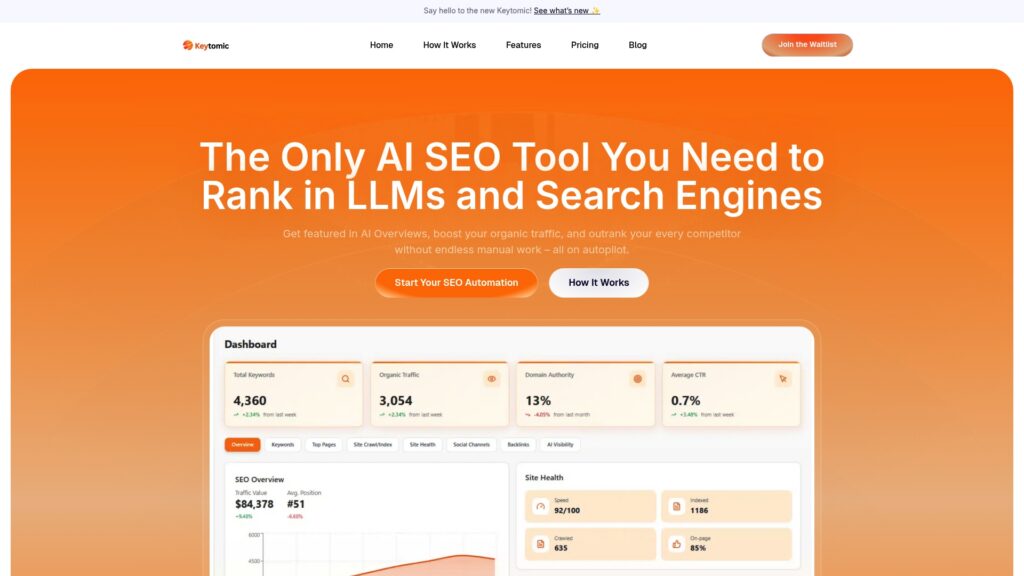
Many content teams operate Ahrefs and Surfer but still face operational bottlenecks. Manual workflows for audits, internal linking, and AI visibility tracking slow execution. Keytomic provides automation infrastructure that complements research and optimization tools.
Keytomic is an all-in-one SEO automation platform designed for content teams shipping consistently while tracking AI search visibility. The platform does not replace Ahrefs research capabilities or Surfer content scoring. Instead, Keytomic automates operational workflows that consume team time without adding strategic value.
Key Features Organized by Workflow Stage
Automated Technical and Content Audits: Keytomic runs continuous site health monitoring. The platform identifies technical issues including broken links, slow loading pages, missing schema markup, and indexing problems. Content audits flag thin pages, duplicate content, and missing entity coverage. These automated checks prevent issues from accumulating.
On-Page Optimization During Drafting: Real-time content analysis provides optimization suggestions while writers draft. Entity coverage recommendations ensure comprehensive topical treatment. Heading structure analysis validates information hierarchy. This guidance operates similarly to Surfer but integrates into publishing workflows.
Automated Internal Linking Suggestions: The platform analyzes content relationships across sites. Smart internal linking suggestions connect related pages to strengthen topical authority clusters. This automation eliminates manual linking decisions that consume editor time.
Citation Tracking Workflows for AI Visibility: Systematic monitoring tracks brand mentions across ChatGPT, Perplexity, Google AI Overviews, and Claude. Automated queries test visibility for target keyword portfolios. Citation tracking dashboards show which content AI platforms reference. This infrastructure scales AI visibility monitoring beyond manual testing.
Actionable Reporting Dashboards: Reports map directly to workflow actions. Dashboards show what changed, what requires attention, and what team members should do next. This action orientation reduces reporting interpretation time.
How Keytomic Helps Content Teams Win GEO
Teams shipping consistent content while tracking AI visibility benefit most from Keytomic automation. The platform handles operational tasks like audits, on-page checks, internal linking, and citation monitoring. Content strategists focus on research and planning rather than execution mechanics.
Automation ensures consistency across high-volume content production. Every page receives optimization checks. Internal linking follows strategic patterns. Citations receive systematic monitoring. Quality remains consistent without proportional time investment.
Teams wanting complete manual control find less value in automation platforms. Agencies preferring hands-on optimization for every client page operate better through Surfer’s manual guidance. Keytomic serves teams prioritizing scalable consistency over customized craft.
Start Your Keytomic Trial Today!
Don’t rely on guesswork and outdated SEO strategies. Let Keytomic automate your SEO workflows so you can focus on what matters most — your brand.
Cancel Anytime. 14-Day Money Back Guarantee.
Comparison Table: Keytomic vs Surfer vs Ahrefs vs Other AI SEO Tools
Table 3: SEO Tools Capability Comparison
| Capability | Keytomic | Surfer SEO | Ahrefs | Semrush | Frase | Clearscope |
|---|---|---|---|---|---|---|
| Keyword Research Depth | Basic | Limited | ✓ Comprehensive | ✓ Comprehensive | Limited | Limited |
| Backlink Intelligence | – | – | ✓ Industry-leading | ✓ Strong | – | – |
| Content Editor | ✓ Integrated | ✓ Market leader | – | Basic | ✓ Good | ✓ Good |
| On-Page Entity Coverage | ✓ Automated | ✓ Manual suggestions | – | Limited | Limited | Limited |
| Technical Audits | ✓ Continuous | Basic | ✓ Comprehensive | ✓ Comprehensive | – | – |
| Internal Linking Automation | ✓ Smart suggestions | – | Manual analysis | Manual analysis | – | – |
| AI Visibility Tracking | ✓ Multi-platform | – | – | – | – | – |
| Citation Tracking Workflow | ✓ Systematic | – | – | – | – | – |
| Team QA Checklisting | ✓ Built-in | – | – | – | – | – |
| Reporting Dashboard | ✓ Action-focused | Basic | ✓ Comprehensive | ✓ Comprehensive | Basic | Basic |
| Automation Layer | ✓ Core focus | – | – | Partial | – | – |
| Starting Price | $99/month | $89/month | $129/month | $139/month | $45/month | $170/month |
Best-Fit Guidance: Who Should Consider Keytomic
Content teams needing repeatability and visibility tracking gain clear value. Agencies standardizing quality across multiple writers benefit from automated QA. In-house teams scaling content volume without proportional headcount increases use automation to maintain quality.
Teams already operating Ahrefs for strategy and Surfer for optimization can add Keytomic for operational automation. This configuration covers research, optimization, and execution workflows comprehensively.
Businesses wanting high-touch manual control for every page should continue using traditional optimization tools. Custom craft approaches suit boutique agencies and premium content services. Automation platforms serve volume-focused operations prioritizing scalable consistency.
Frequently Asked Questions
What is the difference between Ahrefs and Surfer SEO?
Ahrefs specializes in SEO strategy through competitive research, backlink analysis, and keyword difficulty assessment. Surfer SEO focuses on content optimization with real-time on-page scoring and term coverage suggestions. Ahrefs identifies what content to create while Surfer guides how to optimize during writing. Most professional teams use both platforms because they serve complementary functions.
Is Surfer SEO better than Semrush?
Surfer SEO provides superior content optimization guidance compared to Semrush. The platform offers more detailed on-page scoring and better writing workflow integration. Semrush delivers stronger keyword research capabilities and comprehensive site auditing. Teams prioritizing content quality benefit more from Surfer. Teams requiring all-in-one SEO platforms including rank tracking and competitor analysis choose Semrush.
Is Ahrefs good for SEO?
Yes, Ahrefs ranks among the top three SEO platforms globally. The tool maintains the largest commercial backlink database with 24 trillion indexed links. Keyword research capabilities cover 170 billion keywords across 170 countries. Site audit features identify over 130 technical issues. Professional SEO specialists and agencies rely on Ahrefs for competitive intelligence and strategic planning.
Which SEO tool is best?
No single SEO tool serves all needs optimally. Ahrefs excels at competitive research and backlink analysis. Surfer leads content optimization and writing guidance. Semrush provides comprehensive all-in-one capabilities. The best tool depends on primary workflow requirements. Content-focused teams benefit most from Surfer. Strategy-heavy operations require Ahrefs. Teams wanting single-platform consolidation choose Semrush despite trade-offs in specialized capabilities.
Which is better Ahrefs or Semrush?
Ahrefs maintains superior backlink database size and update frequency. The platform indexes 24 trillion backlinks compared to Semrush’s smaller database. Keyword research accuracy favors Ahrefs for search volume data. Semrush offers broader feature coverage including social media monitoring, PPC research, and content marketing planning. Technical SEO auditing capabilities remain comparable. Choose Ahrefs for backlink-focused work and research depth. Choose Semrush for integrated marketing platform consolidation.
What is the 80/20 rule for SEO?
The 80/20 rule states that 80% of SEO results come from 20% of optimization efforts. Applied practically, this means comprehensive content addressing search intent, strategic internal linking between related pages, technical fundamentals ensuring crawlability and page speed, and systematic measurement tracking produce the majority of ranking improvements. Advanced tactics like schema optimization and structured data contribute smaller incremental gains. Focus execution on high-impact basics before pursuing marginal optimizations.
Can I use Surfer SEO without Ahrefs?
Yes, Surfer SEO functions independently for content optimization. The platform provides keyword research through Content Planner and SERP analysis through Content Editor. Teams focusing purely on content quality without competitive intelligence needs operate successfully using only Surfer. Limitations emerge when strategic decisions require backlink context or comprehensive competitor analysis that Surfer lacks.
Do agencies need both Surfer and Ahrefs?
Most agencies require both platforms for complete client service. Ahrefs handles competitive audits, content gap analysis, and backlink research during strategic planning. Surfer standardizes content quality across multiple writers producing client deliverables. Combined investment typically ranges from $300 to $800 monthly depending on client count and usage volume. Single-tool operations create service delivery gaps in either strategy or execution.
Is Surfer SEO worth it for small teams?
Yes, small content teams gain significant value from Surfer subscriptions. The Essential plan costs $89 monthly and optimizes 30 articles. Content quality improvements from real-time optimization guidance produce measurable ranking gains. Return on investment appears quickly for teams publishing 5-10 articles monthly. Solo writers producing fewer pieces may find free optimization tools sufficient until content volume justifies platform investment.
Is Ahrefs enough for on-page optimization?
No, Ahrefs lacks dedicated on-page optimization features. The platform identifies topics worth creating and shows competitor content structure. Writers receive no real-time feedback during drafting. Teams relying solely on Ahrefs must manually interpret competitive analysis into optimization decisions. Combining Ahrefs strategic intelligence with Surfer tactical guidance produces optimal results.
Which tool is better for AI SEO workflows?
Neither Ahrefs nor Surfer directly optimizes for AI search visibility. Both tools indirectly support Generative Engine Optimization through comprehensive content coverage and entity mentions. Surfer ensures topical completeness that improves AI citation potential. Ahrefs identifies comprehensive topic coverage through competitive research. Dedicated AI SEO platforms provide superior citation tracking and AI visibility monitoring compared to traditional SEO tools.
What is the best SEO tool stack in 2026?
The optimal 2026 SEO tool stack combines Ahrefs for competitive research and backlink analysis, Surfer SEO for content optimization during writing, Google Search Console for performance monitoring and indexing verification, and specialized automation platforms for technical audits and AI visibility tracking. This configuration covers strategy development, content execution, performance measurement, and emerging AI search requirements. Budget-conscious teams prioritize Surfer for content quality and Google Search Console for free performance data.
Wrapping Up
Ahrefs and Surfer SEO serve fundamentally different purposes in modern SEO operations. Ahrefs provides strategic intelligence through competitive research, backlink analysis, and comprehensive keyword data. This capability makes Ahrefs essential for SEO strategists and agencies developing content roadmaps. Surfer SEO delivers tactical content optimization through real-time scoring and term coverage suggestions. This functionality makes Surfer indispensable for writers and content teams executing content production.
Solo writers gain maximum value from Surfer subscriptions because content quality improvements directly impact ranking success. SEO strategists benefit most from Ahrefs because competitive intelligence informs high-level content investment decisions. Agencies typically require both platforms because complete client service demands both strategic planning and execution quality.
Budget-constrained teams should prioritize Surfer if focused primarily on content creation. Research capabilities can partially substitute through manual SERP analysis and free tools. Content optimization quality cannot easily replicate without dedicated platforms.
Teams prioritizing AI search visibility should consider automation platforms like Keytomic that provide systematic citation tracking workflows. Neither Ahrefs nor Surfer directly monitors brand mentions in ChatGPT, Perplexity, or Google AI Overviews. This emerging requirement increasingly influences tool selection as AI search adoption grows.
Explore Keytomic for SEO automation that complements existing tool investments or book a demo to see systematic AI visibility tracking workflows.